What Is Digital Railway Documentation and Why Is e-SMGS Changing Cross-Border Rail Freight?
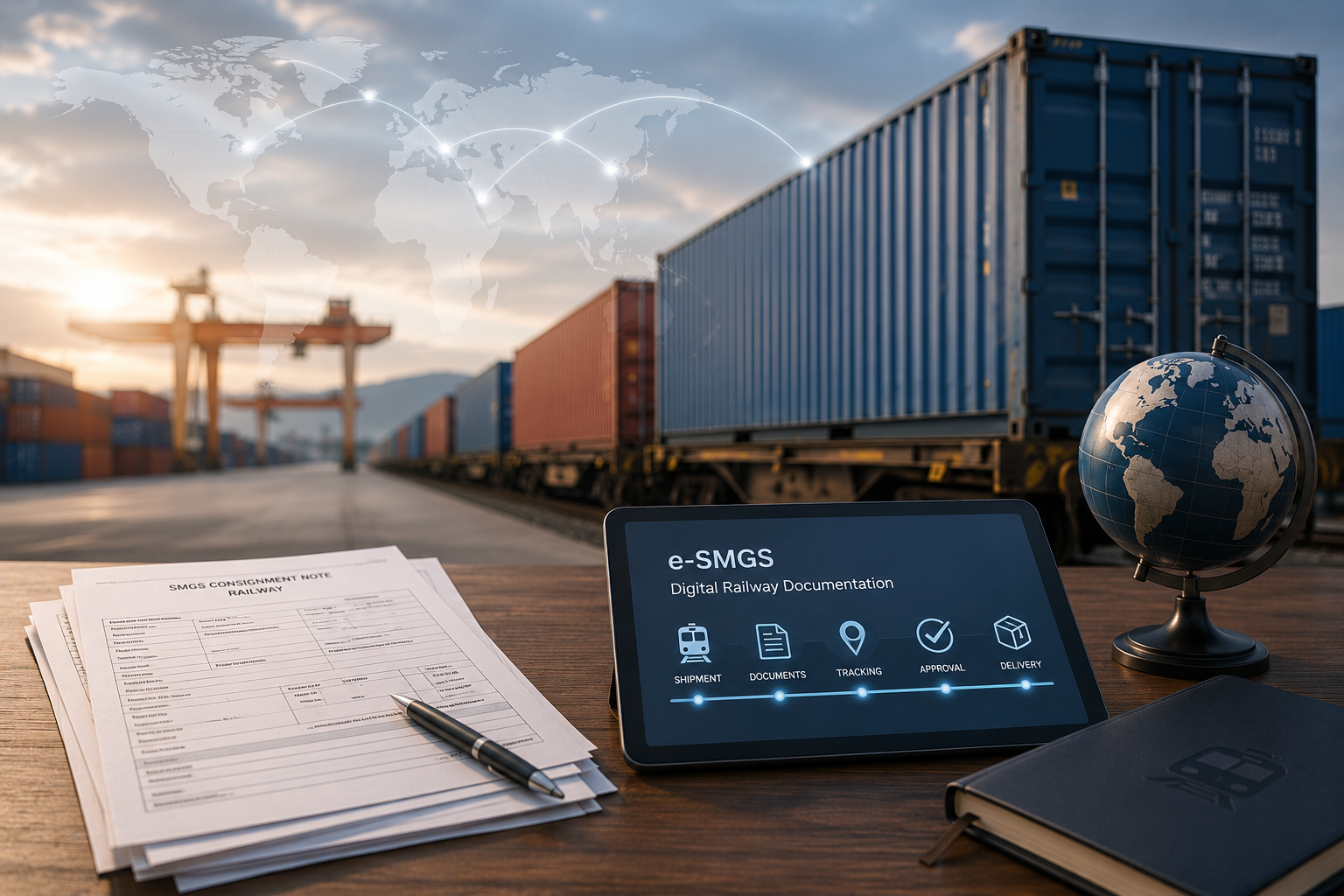
Digital Railway Documentation is no longer just another logistics technology trend. For companies moving cargo across international rail corridors, it is becoming a practical way to improve document accuracy, strengthen coordination between railway operators, and support faster information exchange across borders. As international rail freight grows more complex, relying entirely on paper documentation can increase administrative workload, create inconsistencies between transport documents, and make cross-border coordination more difficult.
Moreover, the shift toward digital documentation has accelerated as governments, railway organizations, and logistics providers continue investing in digital trade initiatives. Instead of viewing railway documentation as a collection of independent paper forms, many stakeholders now see it as part of a connected digital information flow that supports the entire transport process.
Why Digital Railway Documentation Matters
In simple terms, Digital Railway Documentation refers to the creation, exchange, validation, and management of railway transport documents in electronic form throughout the shipment lifecycle. Rather than relying solely on printed paperwork, authorized participants exchange digital transport data between railway undertakings, freight forwarders, customs authorities, and logistics partners using standardized electronic systems.
Among these developments, e-SMGS (electronic SMGS) has become one of the most important advances in Eurasian rail freight. If you are unfamiliar with the traditional railway consignment note, our guide to SMGS Consignment Note explains how the document supports international rail freight before digital workflows are introduced.
The e-SMGS framework has been developed within the broader railway cooperation environment coordinated by the OSJD (Organization for Cooperation of Railways).
Unlike the traditional SMGS consignment note, which has historically relied on paper documentation, e-SMGS represents the digital exchange of SMGS transport information where railway operators, digital infrastructure, and regulatory requirements support electronic processing. Its purpose is not simply to replace paper with digital files but to improve data consistency, reduce repetitive document handling, and create better visibility across international rail shipments.
One important point is often misunderstood.
Digital railway documentation does not mean that every international rail corridor has become completely paperless.
Instead, the level of digital adoption still varies between countries, railway operators, customs authorities, and individual transport corridors. Some cross-border rail movements support extensive electronic document exchange, while others continue using hybrid workflows that combine electronic information with paper documentation. For example, one rail corridor may allow railway operators to exchange transport data electronically while customs authorities still require selected paper documents during border clearance. As a result, companies cannot assume that every shipment follows the same digital process.
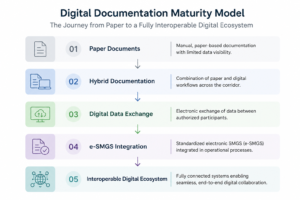
This Digital Railway Documentation Maturity Model explains the progressive adoption of digital railway workflows, highlighting how e-SMGS and interoperable information systems support more efficient cross-border rail freight operations across Eurasian corridors.
Why Documentation Readiness Matters
For freight forwarders and international shippers, this distinction matters more than it may appear. Successful shipment planning depends not only on selecting the right transport route but also on understanding documentation workflows, especially when planning China–Central Asia Rail Freight or Rail Freight to Kazakhstan, where documentation requirements may differ between transport corridors.
Therefore, experienced logistics teams evaluate documentation requirements before cargo reaches the departure terminal. Instead of asking whether a shipment is “digital” or “paper-based,” they assess the level of digital integration across the entire transport chain, including railway operators, customs procedures, and participating organizations.
A Practical Framework for Understanding Digital Railway Documentation
| Documentation Element | Why It Matters | Current Adoption | Potential Operational Impact |
|---|---|---|---|
| Digital transport data | Improves consistency between participating organizations | Increasing | Reduces manual data duplication |
| e-SMGS workflow | Supports standardized electronic document exchange where available | Expanding | Improves coordination across rail corridors |
| Hybrid documentation | Allows digital and paper workflows to operate together | Common | Supports corridors with mixed digital readiness |
| Railway operator readiness | Determines how digital information is processed | Varies by operator | Different implementation levels may affect workflow efficiency |
| Customs coordination | Influences cross-border document acceptance | Developing | Hybrid documentation may still be required |
| System interoperability | Enables communication between different digital platforms | Developing | Limited interoperability can affect information exchange |
This framework highlights an important reality: adopting digital railway documentation is not a single software decision. Instead, it requires coordination between legal frameworks, railway companies, customs authorities, digital platforms, and operational procedures.
Consequently, organizations increasingly evaluate documentation readiness alongside route planning. Even when two rail corridors connect the same origin and destination, the overall documentation workflow may differ depending on participating railway administrations and the digital maturity of each transport corridor.
Understanding this difference leads to a more practical question:
If digital documentation is not fully paperless yet, why are railway operators, customs authorities, and governments investing so heavily in systems such as e-SMGS?
Why Are Railway Operators Investing in e-SMGS and Digital Documentation?
Digital Railway Documentation is changing how information moves across international rail corridors, but the biggest transformation is not the technology itself. Instead, it is the way railway operators, customs authorities, freight forwarders, and logistics companies coordinate the same shipment using shared digital information. As rail freight networks become more interconnected, consistent documentation has become just as important as reliable infrastructure.
For decades, international rail shipments depended on paper documents such as the SMGS Consignment Note, which remains one of the most widely used railway transport documents across many Eurasian rail corridors. While this approach remains necessary in many corridors, it often requires the same shipment information to be entered, verified, or exchanged multiple times by different organizations. Consequently, every additional manual step creates another opportunity for inconsistencies, delays, or communication gaps.
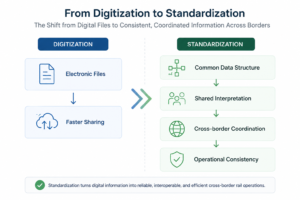
The journey from digitization to standardization demonstrates that successful Digital Railway Documentation depends on consistent data structures, interoperable information exchange, and coordinated international rail freight workflows—not simply replacing paper with digital files.
Digital Documentation Is About Better Information Flow
One of the biggest misconceptions is that e-SMGS exists simply to eliminate paper. In reality, its broader objective is to improve how transport information moves between organizations participating in the shipment.
Rather than treating documentation as a collection of isolated forms, digital workflows allow authorized stakeholders to exchange structured transport data more consistently throughout the journey. As a result, railway operators can process information more efficiently, freight forwarders gain better visibility into documentation status, and logistics teams spend less time resolving discrepancies between different transport documents.
However, digital documentation does not operate independently. It functions alongside operational procedures, customs requirements, railway regulations, and national legal frameworks. Even when one railway administration supports electronic document exchange, another organization within the same transport corridor may still rely on hybrid documentation procedures. For example, a railway operator may exchange shipment data electronically while customs authorities at a border crossing still require supporting paper documents for regulatory purposes.
For this reason, digital transformation in rail freight is usually gradual rather than immediate.
Why Standardization Matters More Than Digitization
The real value of e-SMGS comes from standardization rather than simple digitalization.
International rail shipments often involve multiple railway administrations, border crossings, customs authorities, inland terminals, and freight forwarders. If every participant exchanges information using different document structures or incompatible systems, electronic workflows provide only limited operational benefits. In practice, standardized data also reduces the need to re-enter the same shipment information across multiple organizations, improving consistency throughout the transport process.
Standardized documentation creates a common information structure that participating organizations can interpret more consistently. Therefore, digital railway documentation supports cooperation across complex international rail networks instead of simply replacing printed documents with electronic files.
This principle becomes increasingly important along Eurasian rail corridors, where a single shipment may pass through several railway administrations before reaching its final destination.
Framework: What Drives Successful Digital Railway Documentation?
| Success Factor | Why It Matters | Who Benefits | Operational Benefit | Current Industry Trend |
|---|---|---|---|---|
| Standardized document structure | Creates consistent transport information | Railway operators, freight forwarders | Fewer documentation inconsistencies | Expanding |
| Electronic data exchange | Supports faster information sharing | Railway operators and shippers | Better coordination between participants | Increasing |
| Railway operator cooperation | Improves cross-border interoperability | All transport stakeholders | Smoother document processing | Developing |
| Customs alignment | Supports document acceptance during border procedures | Customs authorities and shippers | Reduced administrative complexity | Varies by country |
| Digital interoperability | Connects different logistics and railway systems | Entire supply chain | More reliable information exchange | Continuing to develop |
The framework demonstrates that successful digital documentation depends on cooperation rather than technology alone. Even the most advanced electronic document cannot improve cross-border operations if participating organizations use incompatible procedures or different regulatory requirements.
Documentation Readiness Supports Better Route Planning
Today, experienced freight forwarders evaluate documentation readiness alongside route selection. Similarly, companies planning China–Central Asia Rail Freight, Rail Freight to Kazakhstan, or Multimodal Rail Transport increasingly assess documentation requirements before confirming transport arrangements. This approach helps reduce operational uncertainty before cargo reaches the departure terminal.
Documentation planning also supports better communication between logistics providers and customers. Instead of correcting document issues during transit, project teams can identify potential inconsistencies earlier, when adjustments are typically easier to manage.
Another important consideration is interoperability. Many organizations already use transportation management systems, customs platforms, or enterprise software to manage freight operations. The long-term value of digital railway documentation depends on how effectively these systems exchange structured transport information across organizational boundaries.
Digital transformation, therefore, is not a single software upgrade. It is an operational change that depends on coordination between infrastructure, documentation, regulation, and people.
Understanding why digital documentation matters naturally leads to the next question:
What actually happens to an e-SMGS document from the moment a shipment leaves the origin until it reaches its destination?
How Does Digital Railway Documentation Work Throughout an International Rail Shipment?
Digital Railway Documentation delivers its greatest value when a shipment moves across multiple railway networks rather than remaining within a single domestic system. At that point, accurate document exchange becomes just as important as moving the cargo itself. Every railway administration, freight forwarder, terminal operator, and customs authority depends on receiving consistent transport information throughout the journey.
Unlike traditional paper workflows, digital documentation is designed to accompany the shipment as structured data rather than as a collection of isolated documents. Consequently, the focus shifts from physically transferring paperwork to ensuring that every authorized participant receives the correct transport information at the appropriate stage of the shipment.
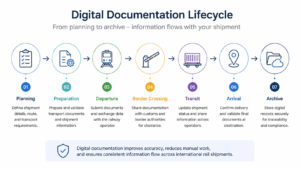
The Digital Documentation Lifecycle demonstrates how Digital Railway Documentation and e-SMGS support consistent information flow throughout international rail freight, helping railway operators, freight forwarders, and customs authorities coordinate shipment data from origin to destination.
The Shipment Lifecycle Begins Before Cargo Moves
Many companies assume that digital documentation starts once cargo leaves the departure terminal. In reality, the documentation process begins much earlier.
Before loading takes place, transport instructions, shipment details, commercial information, and routing decisions must already be aligned between the shipper, freight forwarder, and railway operator. For example, if shipment instructions, cargo descriptions, or consignee information differ between participating organizations before departure, correcting those inconsistencies later may delay border processing or require additional document verification. Small data inconsistencies at the origin often create much larger operational challenges further along the transport route.
For this reason, experienced logistics teams treat documentation preparation as part of shipment planning rather than as a separate administrative task.
Digital Information Travels With the Shipment
One common misconception is that e-SMGS replaces operational communication between transport partners.
Instead, it complements existing operational communication by providing a more consistent digital information layer.
As cargo progresses across international rail corridors, different organizations continue validating transport information according to their operational responsibilities. Railway operators verify transport data, freight forwarders coordinate documentation updates, and customs authorities review the information required for border procedures.
For example, a railway administration may exchange shipment information electronically while customs authorities at a border crossing still require selected supporting paper documents to satisfy local regulatory requirements. Consequently, many international rail corridors currently operate through hybrid documentation workflows rather than completely paperless environments.
Understanding this distinction helps companies develop realistic expectations for digital transformation instead of assuming that every transport corridor follows identical procedures.
Framework: The Digital Documentation Lifecycle
| Shipment Stage | Primary Activity | Main Participants | Digital Documentation Focus | Typical Output |
|---|---|---|---|---|
| Shipment planning | Confirm shipment information | Shipper, freight forwarder | Data accuracy and document preparation | Validated shipment data |
| Departure | Validate transport information | Railway operator | Initial document verification | Transport record |
| Border crossing | Review transport and customs information | Railway operator, customs authority | Information exchange and regulatory compliance | Customs confirmation |
| Transit | Update shipment status | Railway operators, logistics partners | Operational visibility | Shipment status update |
| Destination | Complete delivery documentation | Consignee, railway operator | Final document confirmation | Completed shipment record |
The framework demonstrates that Digital Railway Documentation supports the entire shipment lifecycle rather than a single administrative activity. Every participant contributes different information, and the quality of that information directly influences the efficiency of the overall transport process.
Coordination Matters More Than Technology Alone
Technology enables digital documentation, but coordination determines whether it works successfully in practice.
Similarly, standardized document structures, compatible information systems, operational procedures, and regulatory alignment all influence how effectively digital documentation performs across international rail corridors. Even advanced digital platforms cannot eliminate delays if participating organizations exchange incomplete, inconsistent, or outdated shipment information.
Another important consideration is interoperability. Many railway operators, freight forwarders, customs authorities, and logistics providers continue using different digital systems. Therefore, the long-term success of Digital Railway Documentation depends on those systems exchanging standardized information instead of requiring the same shipment data to be recreated repeatedly.
For logistics professionals, this creates an important operational insight.
The objective is not simply to digitize documents.
The objective is to create a consistent information flow from origin to destination, regardless of how many railway administrations, border crossings, customs authorities, or logistics partners participate in the shipment.
That principle explains why Digital Railway Documentation continues expanding across Eurasian rail freight. Organizations increasingly recognize that reliable information exchange strengthens operational resilience just as much as investments in railway infrastructure, terminal capacity, or border facilities.
As international rail freight continues to digitize, organizations that prepare their documentation processes—not just their transport operations—will be better positioned to improve coordination, reduce administrative friction, and adapt to the next generation of cross-border rail logistics.
Conclusion
Digital Railway Documentation is transforming cross-border rail freight by improving how shipment information moves between railway operators, freight forwarders, and customs authorities. However, successful implementation depends on more than adopting digital tools. Consistent data, standardized documentation, and effective coordination remain essential throughout the shipment lifecycle.
As international rail corridors continue expanding their digital capabilities, companies that prepare their documentation processes before cargo moves will be better positioned to reduce administrative friction, improve operational visibility, and adapt to the future of international rail logistics. In practice, digital transformation is not simply about replacing paper—it is about creating a more reliable flow of information from origin to destination.