
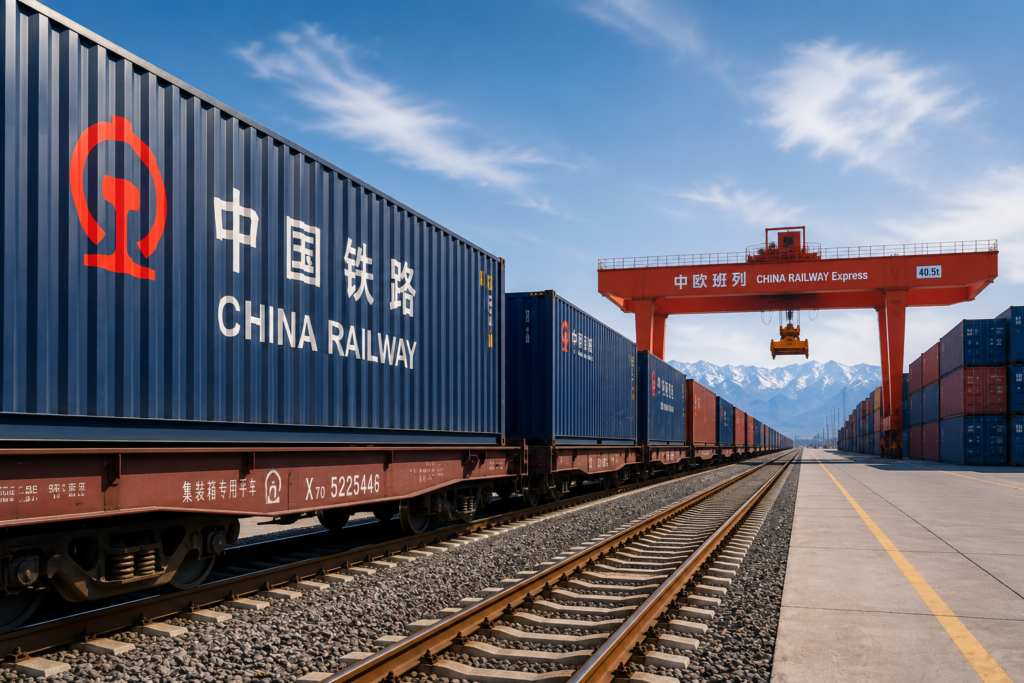
China Central Asia rail freight can be one of the most efficient ways to move cargo into Kazakhstan, Uzbekistan, Kyrgyzstan, Tajikistan, and Turkmenistan. However, choosing the wrong rail route can add days of delay, unexpected border procedures, and unnecessary logistics costs. In today’s logistics environment, success is no longer determined solely by how fast cargo leaves China.
This challenge has become increasingly important as trade flows across Eurasia continue to evolve. In particular, initiatives such as the Belt and Road Initiative (BRI), the expansion of the China Railway Express network, and growing demand from Central Asian economies have strengthened rail connectivity between China and the region. Similar rail links, such as the Tehran–Xi’an rail route, also highlight how regional railway networks are becoming more interconnected across Eurasia.
In simple terms, this rail corridor connects Chinese manufacturing and logistics hubs with major Central Asian markets through a network of international rail routes, border crossings, inland terminals, and regional distribution centers. Typically, cargo originates from cities such as Xi’an, Chengdu, Chongqing, or Urumqi before moving through key China–Kazakhstan gateways and continuing toward destinations including Almaty, Tashkent, Bishkek, Dushanbe, and Ashgabat.
However, one important reality is often overlooked:
The fastest rail route is not always the most reliable one.
A corridor that appears shorter on a map may still experience customs bottlenecks, border congestion, terminal capacity constraints, wagon shortages, or last-mile delivery challenges. Consequently, experienced logistics teams evaluate routes based on overall reliability rather than distance alone.
Why Route Selection Matters More Than Freight Rates
For importers, exporters, manufacturers, and project cargo shippers, selecting the right route often has a greater impact on delivery performance than choosing the cheapest freight rate.
Furthermore, many shipments moving into Central Asia require more than rail transportation alone. Documentation, customs coordination, inland delivery, and multimodal planning can significantly influence shipment performance. Therefore, businesses frequently combine route planning with broader solutions such as China Rail Freight Services and Multimodal Transport Solutions, particularly when cargo must travel beyond the final rail terminal.
Moreover, route selection affects much more than transit efficiency. It can influence customs procedures, cargo handling requirements, border processing times, and even the availability of transport equipment. Because of this, logistics planners often review multiple routing scenarios before booking cargo.
Meanwhile, regional infrastructure continues to evolve. New investments, terminal upgrades, and corridor development projects may improve certain routes while creating temporary operational adjustments on others. Accordingly, route planning should be viewed as a dynamic process rather than a one-time decision.
A Practical Route-Planning Perspective
One of the biggest mistakes shippers make is treating Central Asia as a single logistics market.
In reality, every destination presents a different operational environment.
For example, Kazakhstan serves as the primary rail gateway between China and Central Asia and offers extensive railway infrastructure. By contrast, Uzbekistan functions as one of the region’s most significant commercial destinations and distribution hubs. Meanwhile, Kyrgyzstan, Tajikistan, and Turkmenistan often require additional planning because rail delivery may need to be combined with road transport or other multimodal solutions before cargo reaches its final destination.
Why Destination Differences Matter
This distinction creates a major planning advantage for companies that understand regional logistics dynamics.
While many articles simply discuss “shipping to Central Asia,” successful route planning requires destination-specific analysis. For instance, cargo moving to Almaty faces different operational considerations than cargo moving to Tashkent, Dushanbe, Bishkek, or Ashgabat.
| Planning Factor | Why It Matters | Potential Risk |
|---|---|---|
| Destination Country | Logistics infrastructure differs significantly across Central Asia | Incorrect route selection and higher delivery costs |
| Border Crossing | Different gateways have varying operational conditions | Border delays and congestion |
| Cargo Type | Different products require different transport solutions | Loading restrictions or equipment issues |
| Documentation | Rail and customs documents must remain consistent | Clearance delays and document corrections |
| Final Delivery Location | Many destinations require inland distribution after rail arrival | Additional handling and coordination |
| Transit Conditions | Terminal capacity and wagon availability can fluctuate | Delivery schedule disruptions |
Rather than focusing on a single transit-time figure, shippers should evaluate how these factors interact throughout the journey. In other words, a route that performs well under one set of conditions may be less suitable when border traffic increases, documentation requirements change, or final delivery locations become more complex.
Ultimately, successful China-to-Central-Asia logistics planning is rarely about finding the shortest route. Instead, it is about identifying the route that best balances reliability, documentation requirements, customs procedures, and destination-specific realities.
Therefore, understanding these fundamentals provides a strong starting point. The next step is examining the specific rail routes and border crossings that make this trade corridor work—and why gateways such as Dostyk, Altynkol, and Khorgos play such a critical role in regional freight movement.
Main China–Central Asia Rail Freight Routes
After understanding why route selection matters, the next step is examining how cargo actually moves from China into Central Asia. Although the region is often discussed as a single logistics market, the reality is far more complex. Different destinations depend on different rail corridors, border crossings, inland terminals, and distribution networks. Consequently, the route that works best for Kazakhstan may not be the most efficient choice for Uzbekistan, Kyrgyzstan, Tajikistan, or Turkmenistan.
One of the most important realities of regional logistics is that most rail cargo entering Central Asia passes through Kazakhstan first. Depending on the destination, some shipments continue beyond Central Asia and connect with regional rail networks serving markets such as Iran.
Moreover, growing investment under the Belt and Road Initiative (BRI) and the continued expansion of the China Railway Express network have further strengthened Kazakhstan’s role as a transit hub. As a result, many freight routes serving Central Asia rely on infrastructure that was originally developed to support broader Eurasian trade flows.
The Two Main China–Kazakhstan Gateways
For most shipments, route planning begins with selecting a border crossing between China and Kazakhstan.
According to transport corridor studies published by the Central Asia Regional Economic Cooperation (CAREC) Program, border crossings such as Dostyk and Khorgos continue to play a critical role in regional rail connectivity.
- Alashankou–Dostyk
- Khorgos–Altynkol
Both crossings connect China’s railway system with Kazakhstan’s 1520 mm rail network and play a critical role in regional freight movement.
However, choosing between these gateways is rarely a simple operational decision. Route suitability depends on destination, cargo profile, inland distribution requirements, and overall supply chain strategy.
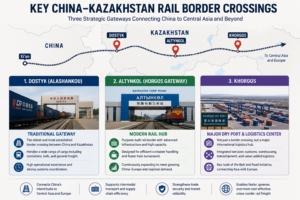
Dostyk, Altynkol, and Khorgos are the primary China–Kazakhstan rail gateways that connect Chinese export hubs with Central Asian markets and the wider Eurasian rail network.
Border Crossing Comparison Framework
| Gateway | Best For | Key Strength | Planning Consideration |
|---|---|---|---|
| Alashankou–Dostyk | Established freight flows and traditional rail routing | Long-standing operational experience | Traffic conditions can vary depending on freight volumes |
| Khorgos–Altynkol | Modern containerized rail freight and logistics operations | Large-scale dry port and logistics infrastructure | Route suitability depends on final destination |
| Both Gateways | Access to Central Asian rail markets | Strong connectivity across regional rail networks | Documentation and customs planning remain essential |
Rather than asking which crossing is better, experienced shippers usually focus on which crossing is better for a specific destination and delivery objective.
For importers, exporters, manufacturers, and project cargo shippers, the gateway decision is often made before freight rates are compared. A well-chosen border crossing can reduce handling complexity, improve schedule reliability, and simplify onward distribution across Central Asia.
Why Kazakhstan Is a Key Rail Gateway for Central Asia and Iran
Kazakhstan occupies a unique position within Eurasian logistics. Nearly every major rail route connecting China with Central Asia relies on Kazakhstan’s infrastructure at some stage of the journey.
This advantage extends beyond geography. The country has invested heavily in railway infrastructure, inland logistics hubs, and cross-border freight facilities that support growing trade volumes. Furthermore, Kazakhstan acts as a bridge between Chinese rail networks and the broader Central Asian transport system.
One of the most important assets is the development of major dry port facilities around the Khorgos–Altynkol gateway. These facilities support cargo transfers, customs procedures, container handling, and onward transportation into neighboring markets.
In addition, Kazakhstan serves both as a destination market and as a transit platform. Cargo moving to Uzbekistan, Kyrgyzstan, Tajikistan, and parts of Turkmenistan often passes through Kazakhstan before reaching its final destination. In some rail freight projects, cargo originating from Xi’an in China continues across Central Asian rail networks and enters Iran through the Incheh Borun border crossing before reaching destinations such as Tehran.
For companies evaluating rail freight opportunities across Central Asia, understanding Kazakhstan’s transit role is often just as important as understanding the final destination itself.
China to Uzbekistan Rail Freight
Uzbekistan represents one of Central Asia’s largest commercial markets and a major destination for containerized cargo, industrial products, consumer goods, and manufacturing inputs.
Unlike Kazakhstan, however, shipments usually continue beyond the initial China–Kazakhstan border crossing before reaching their final destination. Therefore, route planning becomes increasingly important because cargo may move through additional railway systems, customs jurisdictions, and inland terminals.
Furthermore, Uzbekistan’s growing economic activity has increased demand for reliable logistics solutions that connect the country with Chinese suppliers and manufacturing centers.
For businesses evaluating China–Uzbekistan rail freight options, the key consideration is not simply reaching the border. Instead, it is ensuring that the entire logistics chain—from origin terminal to final delivery point—remains efficient and predictable.
Beyond Kazakhstan and Uzbekistan
Other Central Asian markets often require even more detailed planning.
For example, shipments destined for Kyrgyzstan, Tajikistan, or Turkmenistan may involve additional road transportation after the rail leg is completed. Consequently, multimodal transport solutions and intermodal planning often become essential parts of the overall logistics strategy.
In some projects, rail freight continues beyond Central Asia through transit corridors connecting Kazakhstan and Turkmenistan with Iran via the Incheh Borun border crossing. In these situations, rail should not always be viewed as a complete door-to-door solution.
As cargo moves through multiple railway systems, border crossings, and customs jurisdictions, documentation also becomes increasingly important. For that reason, the next section examines transit-time factors, shipping options, and the paperwork requirements that influence China–Central Asia rail freight performance in 2026.
Transit Time Factors, Documentation, and Route Selection for China–Central Asia Rail Freight
One of the most common questions shippers ask is simple:
How long does rail freight from China to Central Asia take?
The answer, however, is rarely straightforward.
Many logistics providers publish estimated transit times, yet real-world performance depends on a combination of operational, infrastructure, customs, and route-planning factors. Therefore, focusing on a single transit-time figure can create unrealistic expectations.
In practice, successful shippers pay closer attention to what influences transit performance rather than chasing the shortest advertised schedule.
Why Transit Times Vary Across Central Asia
A shipment moving from Xi’an to Almaty follows a different logistics profile than cargo moving to Tashkent, Bishkek, Dushanbe, or Ashgabat.
Although rail infrastructure forms the backbone of these movements, several operational variables can affect delivery schedules.
| Transit Time Factor | Potential Impact on Shipment Performance |
|---|---|
| Border processing procedures | Additional inspections or administrative checks |
| Terminal handling capacity | Slower cargo transfers during peak demand periods |
| Wagon and equipment availability | Delays before departure or during transit |
| Documentation accuracy | Clearance interruptions and correction requests |
| Final delivery location | Additional inland transportation requirements |
| Multimodal transfers | Extra handling and coordination steps |
| Seasonal freight demand | Network congestion during peak periods |
The key takeaway is that transit performance is heavily influenced by preparation. Well-planned shipments with complete documentation generally encounter fewer disruptions than cargo requiring corrections during transit.
Consequently, route planning should always consider operational conditions rather than relying solely on estimated schedules.
The Role of SMGS Documentation
Route selection is only one side of the equation.
Documentation plays an equally important role in ensuring cargo moves smoothly across international rail networks.
For most China–Central Asia rail shipments, the SMGS Consignment Note serves as one of the primary transport documents supporting cross-border rail freight operations. This document helps standardize shipment information across participating railway systems and customs jurisdictions.
However, documentation should never be viewed as a simple administrative task.
A mismatch between commercial invoices, packing lists, cargo descriptions, consignee information, or customs declarations can lead to unnecessary delays. In some situations, correcting paperwork after cargo has already entered the rail network can be significantly more complicated than resolving issues before departure.
For this reason, experienced logistics teams typically review all shipment documentation before cargo reaches the departure terminal. Businesses that regularly move freight across Eurasian rail corridors often rely on dedicated rail freight documentation procedures to ensure transport documents, customs data, and shipment instructions remain aligned throughout the journey.
When Rail Alone Is Not Enough
A common misconception is that rail freight always provides a complete door-to-door solution.
In reality, many Central Asian destinations require additional transportation stages after the rail journey ends.
For example, cargo arriving at a rail terminal may still require:
- Local trucking
- Warehouse handling
- Customs release procedures
- Regional distribution
- Cross-border road transport
As a result, many supply chains rely on multimodal transport rather than rail alone.
This approach is particularly common for destinations located away from major railway corridors or for projects requiring delivery to industrial sites, construction zones, mining operations, or inland commercial centers.
In these cases, rail provides the long-distance transport component, while road freight completes the final stage of delivery.
A Practical Route Selection Framework
The best route is not necessarily the shortest route, the cheapest route, or even the fastest route. For example, some shipments originating in Xi’an may travel through Kazakhstan and Turkmenistan before entering Iran via Incheh Borun, demonstrating how route planning often prioritizes network connectivity and operational reliability over distance alone.
Instead, the best route is the one that aligns with the shipment’s operational requirements.
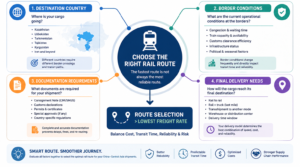
Selecting the right China–Central Asia rail freight route requires evaluating destination markets, border conditions, documentation requirements, and final delivery needs rather than focusing solely on transit time or freight rates.
Before selecting a route, shippers should evaluate:
| Decision Area | Key Question |
|---|---|
| Destination | Which country and city will receive the cargo? |
| Cargo Type | Does the shipment require special handling or equipment? |
| Documentation | Are all rail and customs documents prepared correctly? |
| Border Crossing | Which gateway best supports the destination? |
| Delivery Model | Is rail-only or multimodal transport more suitable? |
| Risk Tolerance | Is reliability more important than theoretical speed? |
This framework often reveals an important reality:
The most efficient logistics solution is not always the most obvious one.
For example, a route with slightly longer transit times may provide more predictable operations, lower administrative complexity, and fewer transfer points. Consequently, many experienced shippers prioritize reliability and visibility over aggressive scheduling assumptions.
How Freight Forwarders Support China–Central Asia Rail Shipments
As routes become more complex, freight forwarders play an increasingly important role in shipment planning.
Rather than simply booking transportation, forwarders help coordinate route selection, documentation review, customs preparation, border-crossing requirements, and multimodal delivery arrangements.
For companies shipping into Central Asia for the first time, coordinating rail routing, customs requirements, documentation, and final delivery through a single logistics partner can significantly reduce operational complexity.
This support becomes particularly valuable when cargo moves through multiple jurisdictions, railway systems, and distribution networks.
By evaluating documentation requirements, operational risks, and destination-specific factors before departure, forwarders help reduce avoidable disruptions throughout the journey. Companies planning rail shipments between China and Central Asia can also request a rail freight quotation before finalizing route and documentation decisions.
Conclusion
The most successful China–Central Asia rail shipments are rarely the ones with the shortest quoted transit time. Instead, they are the shipments supported by the right route, accurate documentation, efficient border processing, and realistic delivery planning.
As trade connections between China and Central Asia continue to expand, businesses that evaluate routing options strategically are often better positioned to reduce risk, improve supply chain visibility, and avoid unnecessary disruptions. Ultimately, understanding how routes, border crossings, documentation requirements, and multimodal delivery options work together is what turns a rail shipment into a reliable logistics solution.