
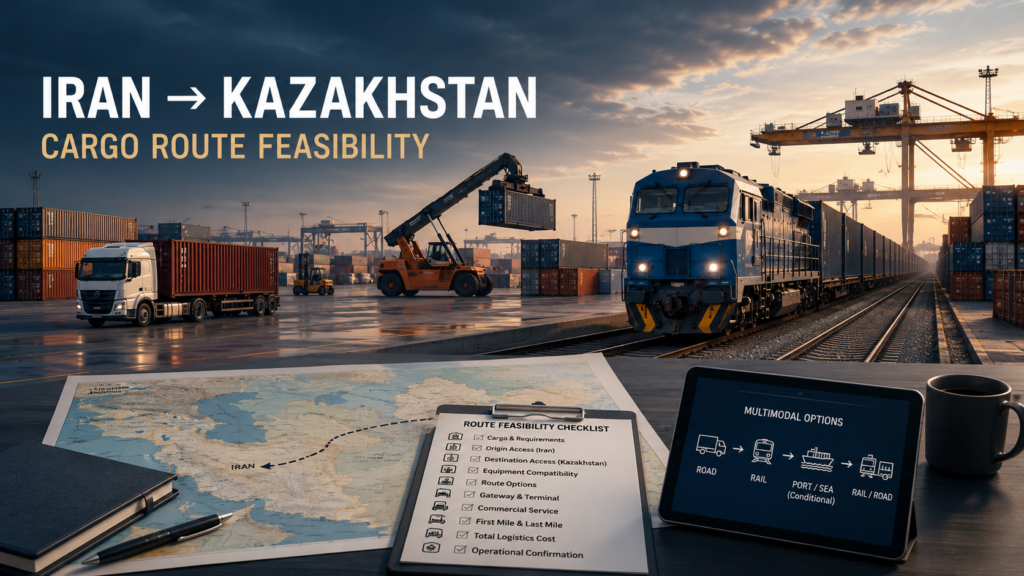
Iran Kazakhstan cargo shipping can appear straightforward when both the Iranian loading point and the Kazakhstan destination have railway access. In practice, equipment compatibility, gateway selection, terminal handling, current commercial service and final delivery conditions can change the entire transport architecture.
That is the central planning issue for a real cross-border shipment. A railway line on a map establishes physical connectivity; it does not establish shipment-specific feasibility. The useful B2B question is whether the actual cargo can move from its Iranian loading point through the required equipment, gateway, terminal and commercial-service interfaces to its final Kazakhstan delivery point.
A Rail Connection Does Not Automatically Create a Door-to-Door Rail Shipment
Iran, Turkmenistan and Kazakhstan are connected through regional rail infrastructure, and current official reporting confirms freight activity on the wider architecture. Kazakhstan’s Ministry of Transport reported that rail freight with Turkmenistan increased by 46% during the first five months of 2026 and that freight volumes on the China–Kazakhstan–Turkmenistan–Iran route increased 2.5-fold. Those figures demonstrate current corridor activity; they do not establish a commercially available service for every Iran–Kazakhstan shipment. Government of Kazakhstan
For route planning, four evidence levels should remain separate:
- Physical infrastructure: the railway, road, port, terminal or interface exists.
- Corridor activity: recent evidence shows freight moving somewhere on the wider architecture.
- Commercial service availability: the required movement can currently be arranged commercially.
- Specific shipment feasibility: the cargo, equipment, origin, destination, terminals and delivery requirements fit the proposed service.
This distinction prevents an infrastructure map, corridor announcement or route calculator from being treated as proof of wagon availability, terminal acceptance, departure frequency or shipment-specific execution. Generic cross-border rail mechanics can be considered separately through Arta Rail’s international rail freight planning guide; this article focuses on the Iran–Kazakhstan shipment decision.
What Must Be Known Before Planning Iran–Kazakhstan Cargo Shipping?
Route selection should begin with the shipment requirements rather than a preferred transport mode. Two exporters moving different cargoes from different Iranian origins to different Kazakhstan destinations may require different gateways, equipment and first/last-mile arrangements even though both describe the task as Iran-to-Kazakhstan freight.
Cargo Profile and Shipment Scale
The cargo profile establishes physical form, packaging, handling requirements and potential equipment constraints. Shipment scale and frequency also affect the architecture, but volume alone does not make rail the correct choice: loading capability, terminal access and final delivery may change the result.
| Shipment Variable | Decision It Changes | Required Information |
|---|---|---|
| Cargo profile | Handling and equipment | Commodity, physical form, packaging, special handling |
| Shipment scale and frequency | Mode and service architecture | Weight/volume and one-off or recurring movement |
| Iranian origin | First mile and gateway access | Exact loading point and practical road/rail access |
| Kazakhstan destination | Terminal and last mile | Final delivery point and unloading capability |
| Equipment requirement | Route compatibility | Wagon, container or truck requirement where known |
| Loading/unloading capability | Terminal dependence | Ability to handle the proposed equipment |
| Delivery constraints | Route and mode choice | Required timing and final-delivery conditions |
| Incoterm | Commercial responsibility | Which parts of the logistics chain must be controlled and priced |
Exact Origin, Loading Point and First Mile
An origin city is not sufficiently precise. Planning needs the actual loading point and a realistic method for connecting that site to the main transport mode.
An industrial site with suitable rail loading may support one architecture, while another origin may require a road feeder to a rail terminal. If that first-mile movement is impractical, an apparently attractive rail route can lose its advantage before the international main haul begins.
Final Kazakhstan Destination, Unloading and Last Mile
“Kazakhstan” is equally insufficient as a final destination. A consignee with usable rail access presents a different logistics problem from a facility requiring road delivery from a destination terminal.
Unloading capability matters as well. If the receiving site cannot handle the proposed equipment, the route may require a different terminal or delivery architecture. A road last mile therefore does not mean a rail-based solution has failed; it may be the component that makes the main-haul rail movement executable.
Which Routes Are Relevant for Iran–Kazakhstan Cargo Shipping?
Several route architectures are relevant enough to evaluate, but none should be treated as universally preferable. Broader regional context belongs in Arta Rail’s Iran–Central Asia rail corridor guide; shipment-level feasibility requires a narrower analysis.
Kazakhstan–Turkmenistan–Iran Rail via Incheh Borun
Incheh Borun is a relevant Iran–Turkmenistan rail interface on the Kazakhstan–Turkmenistan–Iran architecture. In April 2025, Turkmenistan’s railway operator documented a test container movement from Russia that travelled through Kazakhstan and Turkmenistan before reaching Etrek and Incheh Borun, where the containers continued by road toward Afghanistan. This provides direct evidence that the interface was used in that wider international movement. Demirýollary
Combined with Kazakhstan’s 2026 reporting on increased activity on the wider China–Kazakhstan–Turkmenistan–Iran route, the evidence supports the interface’s structural and corridor relevance. It still leaves shipment-specific questions unanswered, including current service arrangements, equipment, cargo acceptance and terminal conditions.
When Sarakhs May Be Relevant
Sarakhs is a separate Iran–Turkmenistan gateway serving broader Central Asian rail connectivity. It should not be presented as another name for Incheh Borun or as an automatically interchangeable alternative.
A September 2025 report from Turkmenistan’s State Service of Maritime and River Transportation described development of the Sarakhs rail terminal and separately referred to routes through Sarakhs and Incheh Borun. This supports Sarakhs’ structural relevance to Central Asian freight, while its suitability for a Kazakhstan shipment still depends on the actual origin, destination, equipment, routing and current commercial service.
Rail-network compatibility is another consideration. UNESCAP documentation identifies the principal Iranian railway gauge as 1,435 mm and the networks of Kazakhstan and Turkmenistan as 1,520 mm. UNESCAP Trans-Asian Railway documentation This difference can create operational interface requirements, but the gauge distinction alone does not establish that every shipment is transloaded, requires bogie exchange or follows one universal transfer procedure. The actual method depends on route, equipment, terminal, operator and current service arrangements.
Road and Mixed Rail–Road Architectures
Road can perform the complete international movement or solve a specific access problem within a rail-based architecture. It may connect an Iranian loading point to a suitable terminal, complete delivery from a Kazakhstan rail terminal, or form both access legs around a rail main haul.
Mixed mode is useful when the mode change solves a real constraint. Adding road, rail or sea legs merely because they are available can instead create extra handling and coordination without improving the shipment.
| Route / Gateway Architecture | Verified Structural/Corridor Fact | Operational Implication | Current Validation Required |
|---|---|---|---|
| Rail via Incheh Borun | Established Iran–Turkmenistan interface with documented wider international movement | Relevant north–south architecture to evaluate where origin, destination, equipment and current service fit | Service arrangement, equipment, terminal conditions and cargo acceptance |
| Sarakhs-related rail architecture | Separate Iran–Turkmenistan gateway serving Central Asian connectivity | May fit a different route, origin or service architecture | Relevance to the specific Kazakhstan movement and current service |
| Road | Regional road networks permit road-based freight architecture | Can perform the full movement or solve first/last-mile access | Current carrier, border, equipment and cargo-specific conditions |
| Road–rail / rail–road | Mixed-mode architecture combines terminal access with rail main haul | Useful where a mode change solves a defined access or network constraint | Terminal, equipment, transfer and service compatibility |
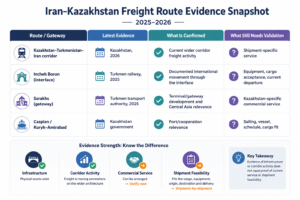
Current evidence confirms infrastructure or wider corridor activity for several Iran–Kazakhstan freight architectures, while commercial service and shipment feasibility still require current validation.
Can a Caspian Route Be a Practical Alternative?
A Caspian-connected architecture may be relevant, but it should remain a conditional alternative rather than automatically becoming a co-primary route.
Kazakhstan has officially discussed transport development involving Kuryk and Iran’s Amirabad port as part of broader transport cooperation. That type of evidence can establish port and corridor relevance; it should not be converted into a claim that a suitable current sailing, vessel, capacity or schedule is available for a specific shipment. Government of Kazakhstan
A possible architecture could involve an Iranian inland movement, an Iranian Caspian port, a sea leg to Kazakhstan and onward rail or road delivery. Because that design introduces port handling and another modal interface, it should solve a genuine geographic, access or network constraint before the added complexity is justified. The same principle applies more broadly to multimodal transport in the Middle East: more modes do not automatically create better logistics.
What Can Make a Rail Route Operationally Infeasible?
Infrastructure vs Commercial Service
A physical railway establishes network access, while current corridor activity shows that freight is actually moving somewhere on that network. The next questions become progressively more specific: whether a suitable commercial service can currently be arranged, and whether that service fits the cargo, equipment, origin, destination, terminal and delivery requirements of the shipment.
This is also why automated route output has limited evidentiary value. A map or calculator can identify a possible physical architecture, but it cannot by itself confirm current equipment, terminal acceptance, commercial service, interface handling or final delivery.
Equipment, Transfer and Terminal Requirements
Cargo may require a particular wagon, container or road equipment, and the proposed route must support that requirement through the complete chain. The receiving location must also be capable of handling the equipment, either directly or through an appropriate terminal.
Network interfaces add another variable because the rail systems are not technically uniform. The planning task is therefore to identify the interface and obtain current operational confirmation rather than assume a universal transfer procedure from the gauge difference alone.
Consider a hypothetical cargo whose Iranian loading point and Kazakhstan destination both appear rail-served. End-to-end rail still depends on equipment compatibility, gateway choice, terminal requirements, current service and unloading conditions. If a final road leg resolves the destination constraint, rail plus road may be more executable than trying to preserve rail simply for the sake of modal continuity.
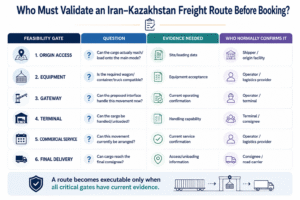
Iran–Kazakhstan cargo route feasibility depends on current evidence across origin access, equipment, gateways, terminals, commercial service and final delivery before booking.
Iran–Kazakhstan Cargo Shipping by Rail, Road or Multimodal Transport?
Rail, road and multimodal transport can all be relevant for Iran–Kazakhstan cargo, but the appropriate choice depends on the shipment rather than the country pair alone. Rail may be worth evaluating where loading access, equipment, gateways, terminals and current commercial service align. Road can provide the complete movement or solve first- and last-mile access constraints. A multimodal architecture can combine these modes when the transfer solves a specific operational problem rather than simply adding another transport leg.
If the shipment is still at the mode-selection stage, compare the operational and cost implications in Arta Rail’s rail freight vs road freight guide before evaluating a specific route architecture.
Freight Rate vs Total Logistics Cost
A main-haul freight rate and the delivered logistics cost are not the same commercial measure. Different architectures place costs in different parts of the transport chain, so comparing two headline rates can be misleading when their commercial scopes differ.
| Cost Component | When It Applies | Why It Matters |
|---|---|---|
| First-mile pickup | Origin is away from the main loading point | Determines the practicality and cost of reaching the primary mode |
| Origin loading/handling | Cargo requires terminal or specialized handling | Can affect both feasibility and cost |
| Main freight | Every route | Usually the most visible component, but only one part of delivered cost |
| Gateway/terminal operations | Architecture requires gateway or terminal handling | Adds route-specific cost and operational dependency |
| Transfer/transloading | Only where the selected service requires it | Adds handling and must not be assumed universally |
| Port costs | Caspian architecture | Must be included when a sea-connected option is evaluated |
| Destination handling | Cargo terminates at a terminal | Determines what must occur before final delivery |
| Last-mile delivery | Consignee is not directly served by the main mode | Can reverse an apparent main-haul advantage |
The correct comparison is therefore total logistics cost across executable routes, not the lowest isolated freight rate. Feasibility comes first because an inexpensive rate attached to an architecture that cannot support the cargo has little decision value.
The Route Before Rate Shipment Feasibility Framework
The planning logic can be organized as the Proposed Editorial Framework for Arta Rail: Route Before Rate Framework. It is presented here as an editorial decision model, not as a claimed proprietary or established Arta Rail operating methodology.
1. Define the cargo
Establish cargo type, physical form, packaging, shipment scale and handling requirements. These variables determine which equipment and transport architectures are worth evaluating.
2. Confirm origin and loading access
Identify the exact Iranian loading point and determine whether practical road, rail or terminal access exists. This prevents corridor selection from ignoring the first mile.
3. Confirm destination and unloading access
Define the final Kazakhstan delivery point, not merely the country or nearest major city. Include terminal requirements and the consignee’s unloading capability.
4. Identify compatible equipment
Determine the wagon, container or road equipment required where known. Equipment incompatibility can remove an otherwise attractive architecture from consideration.
5. Generate candidate route architectures
Evaluate structurally relevant rail, road, mixed-mode and, where appropriate, Caspian options. This stage generates possibilities rather than selecting a winner.
6. Validate gateway and terminal requirements
Check whether the proposed gateway and terminals fit the cargo, equipment and route. Gateway relevance follows shipment constraints rather than map proximity alone.
7. Validate current service and transfer requirements
Establish whether the relevant commercial movement can currently be arranged and how any required network interface would be handled. Corridor activity alone is insufficient at this stage.
8. Integrate first mile and last mile
Build pickup and final delivery into the architecture before comparing commercial options. Either access leg can change the attractiveness of the main haul.
9. Compare total logistics cost
Compare only the remaining executable architectures and ensure the commercial scopes are equivalent. Include route-specific handling and access costs where applicable.
10. Confirm the operational plan before booking
Recheck current service, equipment, terminal conditions, documentation requirements and operating arrangements before a booking decision.
The sequence matters because it progressively eliminates architectures that cannot support the shipment. Non-executable routes should be removed before freight rates become the deciding factor.
What Information Is Needed for a Meaningful Freight Inquiry?
A useful freight inquiry should describe the shipment well enough for a logistics provider to evaluate the complete movement rather than price an abstract country pair.
Provide the cargo description and physical form, packaging, gross weight and volume where relevant, shipment scale or frequency, exact Iranian origin and loading point, loading capability, final Kazakhstan destination and delivery point, unloading capability, required timing, Incoterm, and any known equipment or special-handling requirements. An HS code may also be relevant where it is needed for the commercial or regulatory assessment.
For controlled, dangerous, chemical, food or other cargo with specific requirements, the applicable conditions need shipment- and route-specific review rather than assumptions drawn from a general country-pair article.
From Route Idea to Executable Shipment
For Iran to Kazakhstan cargo shipping, the strongest freight plan is not necessarily the shortest line on a map or the option with the lowest visible main-haul rate. A defensible decision starts with the cargo and actual loading and delivery points, then tests equipment, gateway, terminal, mode, current commercial service and first- and last-mile requirements before comparing total logistics cost.
For companies evaluating a real shipment, the next step is to prepare the shipment profile, scale, exact Iranian origin and loading point, final delivery destination, unloading conditions, required timing and any known equipment requirements. Those details give a logistics provider enough context to determine whether a proposed transport architecture merits further operational and commercial evaluation.
Once these shipment details are prepared, submit them through Arta Rail’s order page for further evaluation, without assuming in advance that a particular route, mode, capacity or service is available.