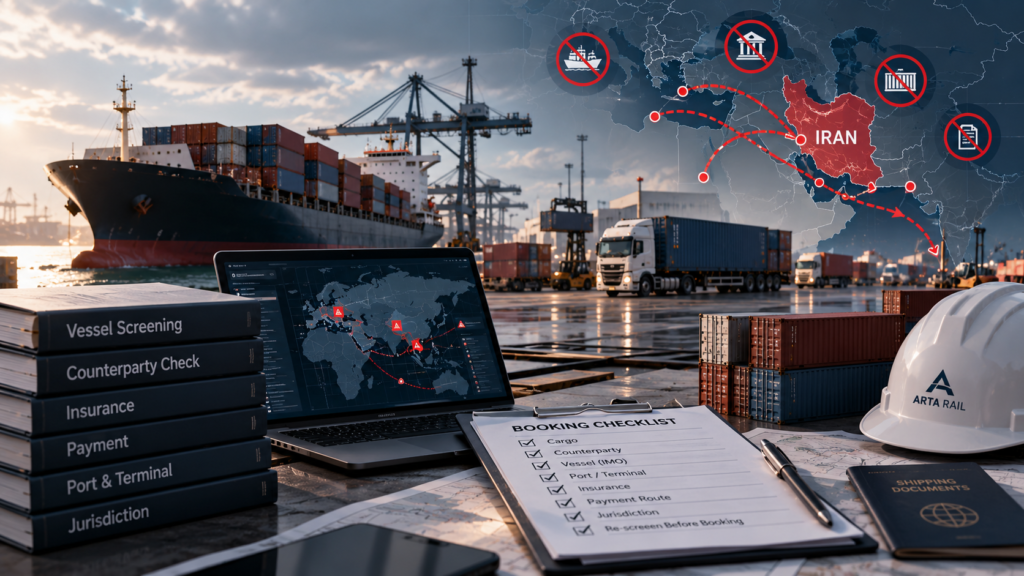
A vessel can be available. The port can be open. The cargo can be physically transportable.
And the shipment can still fail before loading.
That is the operational problem behind the latest Iran shipping sanctions. For freight teams, the question is no longer simply whether a carrier or vessel appears on a sanctions list. A workable booking can depend on the cargo, the parties behind the transaction, vessel ownership and management, financial institutions, insurance, the services required at each port and the jurisdictions involved.
That distinction became more important during 2026.
On July 14, the U.S. Treasury targeted more than 50 individuals, entities and vessels associated with a shipping network it said had expanded beyond Iranian oil exports into global containerized shipping and commodities trading.
A larger change followed on August 24. OFAC determined that Executive Order 13902 would apply to the shipping sector of the Iranian economy, alongside aviation, digital assets, gold and technology. The determination states that a person determined to operate in those sectors may be subject to sanctions. It does not, by itself, turn every shipment with an Iran connection into the same legal case. Justia Regulations
For logistics teams, that makes shipment planning more—not less—shipment-specific.
What Actually Changed for Shipping in 2026?
Much of the search coverage around Iran sanctions focuses on newly designated companies, tankers and political pressure.
Those developments matter, but they are only the beginning of the freight question.
The July action was notable because Treasury said the targeted network had moved into containerized shipping and commodities trading, not only the petroleum tanker activity normally associated with Iranian maritime sanctions.
Then, on August 24, shipping itself was added to the Iranian economic sectors covered by the E.O. 13902 determination. OFAC also announced additional Iran-related designations and continued updating its guidance and authorizations during September. Its current Iran sanctions page shows several new actions within a matter of weeks, including September licensing changes and further designations.
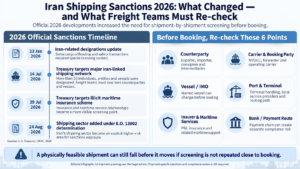
Key U.S. sanctions developments affecting Iran-related shipping in 2026, with six areas freight teams should re-check before final booking.
The compliance environment also changed outside the United States.
New UK measures took effect on September 29, 2026, expanding financial, trade and transport restrictions related to Iran. The UK government says the measures cover areas including maritime goods and technology, while its updated Iran sanctions guidance addresses specified ships, port restrictions and other transport-related controls.
This matters because an international shipment is rarely governed by one relationship alone. The exporter may be in one jurisdiction, the carrier in another, the insurer somewhere else and the payment bank in a fourth.
A route may therefore be physically executable while one part of its commercial chain is not.
A Sanctions Check Is Not Just a Vessel-Name Search
One of the easiest mistakes in shipment planning is to reduce sanctions due diligence to a single question:
Is the vessel on the sanctions list?
That question matters, but it is too narrow.
OFAC’s own Sanctions List Search uses fuzzy logic for names, while other fields operate differently. OFAC also tells users to determine their own matching thresholds based on internal risk assessments and compliance practices.
For ships, identity deserves particular attention because vessel names can change.
An IMO number is generally a stronger identifier than a vessel name alone. Current UK sanctions guidance, for example, states that specified ships are normally identified by IMO number where practicable.
But even an IMO check only answers part of the question.
Consider a vessel that produces no obvious list match. The booking may still involve an owner, manager, charterer, cargo interest, port service provider, insurer or financial institution whose status changes the transaction.
That is why the useful unit of analysis is not simply the ship.
It is the shipment chain.
Seven Different Gates Can Stop the Same Booking
A useful way to think about an Iran-related freight movement is to separate physical transport from commercial execution.
| Booking gate | What the freight team is trying to establish |
|---|---|
| Cargo | Whether the commodity, origin, destination or end use creates restrictions |
| Counterparties | Whether the shipper, consignee and other parties can participate |
| Vessel | Whether the ship and its ownership/management structure are acceptable |
| Carrier & service providers | Whether transport and supporting services can legally and commercially be provided |
| Insurance | Whether required cover can be issued and remain valid |
| Payment | Whether banks can process the transaction |
| Jurisdiction | Which sanctions regimes and company policies apply to the transaction |
Passing one gate does not automatically clear the others.
For example, changing the route does not solve a problem involving a prohibited counterparty. Replacing a vessel does not necessarily solve a banking restriction. A bank accepting the payment does not prove that an insurer will cover the voyage.
This is where sanctions planning becomes a logistics issue rather than a list-search exercise.
Start With the Cargo, Not With the Route
Before asking which carrier can move a shipment, the cargo itself has to be defined properly.
A description such as “industrial equipment” is often too broad for a serious review. The actual commodity, technical specification, origin, destination and intended end use can matter.
The same principle applies when planning cargo movement through Iran. A map can show a technically available transit route, but the cargo and transaction still determine whether that architecture is commercially executable.
This is also why a freight quote should not be treated as the first proof that a shipment can move.
A forwarder may be able to calculate road, rail, ocean or terminal costs before every compliance question has been resolved.
A price is not a clearance decision.
The Counterparty Behind the Booking Matters as Much as the Name on the Booking
International freight transactions can involve more parties than appear on the commercial invoice.
Depending on the structure, there may be exporters, importers, traders, freight forwarders, shipowners, operators, managers, brokers, terminal providers and financial institutions.
Recent U.S. actions illustrate why this wider network matters. Treasury’s July 14 designations covered individuals, companies and vessels across a broader shipping and commodities structure rather than only the physical ships carrying cargo. U.S. Department of the Treasury
This means a freight team should not assume that a clean vessel result settles the transaction.
Ownership, control and linked parties can be relevant, and the applicable test depends on the sanctions regime and jurisdiction involved.
Where the ownership or transaction structure is unclear, that uncertainty itself may need to be resolved before a carrier, bank or insurer is prepared to proceed.
Why the IMO Number Matters
Vessel names are visible. IMO numbers are more useful.
A ship may be renamed, reflagged or transferred between management companies during its operating life. Searching only by its current commercial name can therefore produce an incomplete picture.
The U.S. sanctions lists regularly identify designated vessels with IMO numbers, and the UK’s current Iran sanctions guidance also uses IMO identification for specified ships where reasonably practicable. OFAC
For a freight team, the practical implication is straightforward: vessel screening should follow the vessel’s identity rather than only the name currently painted on its hull.
That still does not finish the review.
A vessel can be clear while another party connected with the fixture is not.
Banks and Insurers Can Change the Commercial Answer
A shipment does not move simply because a freight operator accepts the cargo.
International transportation depends on payment and risk transfer as well.
A transaction may therefore reach a point where the physical logistics remain possible but a bank will not process the payment or an insurer will not provide the required cover.
This distinction has become particularly relevant because the 2026 measures have increasingly targeted not only vessels but also financial and service relationships connected with Iran. The UK’s new maritime measures, for example, extend beyond ship specification into services and transport restrictions, while current professional guidance on the new rules highlights implications for shipowners, charterers, managers, financiers, brokers and insurers. Holland & Knight
A freight company therefore needs to know more than whether a truck, train or ship is available.
It needs to know whether the complete commercial chain can support the booking.
A Physically Open Port Is Not Automatically a Usable Port
Port availability is another area where operational and sanctions questions can become confused.
A port may be functioning normally from an infrastructure perspective while a specific carrier, vessel, service provider or transaction faces restrictions.
The opposite can also happen: a transaction may not appear prohibited at first review, but the carrier’s own policy may exclude the route or cargo.
That difference becomes important in multimodal movements.
A container may arrive by sea and continue by road or rail, but each additional interface introduces another operational party. In a multimodal transport chain through the Middle East, the feasibility of one leg does not automatically validate every other leg.
Changing modes is therefore not a sanctions solution by itself.
The transaction still has to work across the entire chain.
Strait of Hormuz Transit Created a Separate Compliance Question
The Strait of Hormuz produced an especially unusual example in 2026.
OFAC’s current Iran sanctions page carries an August 24 alert on the sanctions risks associated with Iranian demands connected with passage through the Strait.
OFAC has also stated that U.S. persons generally cannot make certain payments to, or receive safe-passage guarantees or related services from, the Government of Iran or the IRGC. Its guidance separately addresses dealings involving the Persian Gulf Strait Authority.
For freight planners, the lesson is broader than Hormuz.
An apparently operational service can itself create a compliance issue depending on who provides the service, who receives payment and which jurisdiction governs the transaction.
That is different from ordinary route feasibility.
It is also why a sanctions-sensitive shipment should not be approved simply because another vessel recently completed the same voyage.
The Jurisdiction Question Should Come Before the Final Booking
There is no single global sanctions rule that can be applied identically to every company.
A U.S. person may face one set of prohibitions. A UK company can face another. Non-U.S. parties may also need to consider exposure to U.S. secondary sanctions and other relevant regimes depending on the activity.
The August U.S. shipping-sector determination is a good example of why wording matters.
It does not say that every person conducting every transaction connected to Iranian shipping is automatically blocked. It allows sanctions to be imposed on persons determined to operate in the designated shipping sector of the Iranian economy. Justia Regulations
At the same time, the UK rules that took effect on September 29 created a separate set of trade, transport and financial restrictions with their own scope. GOV.UK
A multinational shipment may touch both systems—and potentially others.
The correct compliance question is therefore not simply:
“Is shipping to Iran sanctioned?”
It is:
“Which rules apply to this specific cargo, these specific parties and this specific transaction?”
Why Re-Screening Matters After the Quote
A booking can change between quotation and departure.
The nominated vessel can be substituted, ownership may change, and new sanctions actions can be published. At the same time, a bank or insurer may revise its position, while the shipment itself could ultimately be handled by a different operator.
This is particularly relevant in periods of frequent sanctions updates.
OFAC’s Iran program page records multiple Iran-related actions during September 2026 alone, including fresh designations and licensing changes.
So a sanctions review performed while pricing the shipment should not automatically be treated as valid indefinitely.
For longer booking windows, a final verification closer to execution can identify changes that were not present when the original quotation was issued.
This is the operational reason for re-screening before execution, not simply a paperwork exercise.
Example: The Route Works, but the Shipment Does Not
Consider a hypothetical containerized shipment moving from a manufacturer outside Iran to a buyer in the region.
The ocean service is available. The selected port is operating. Inland transport can be arranged, and the cargo itself does not initially appear problematic.
Operationally, the route looks executable.
During final review, however, a company involved in the commercial chain produces a potential sanctions match. The freight team now has to resolve that issue before booking.
Changing the truck route would not answer it.
Using rail instead would not answer it.
Selecting another port might not answer it either.
The bottleneck is no longer transport infrastructure. It is the transaction structure.
This is why sanctions screening should happen before a complex multimodal movement is treated as confirmed.
Does Every Iran-Related Shipment Have to Be Rejected?
No universal answer can be given from the destination country alone.
Iran-related sanctions contain prohibitions, designations, exceptions, licenses and jurisdiction-specific rules. OFAC‘s current Iran program page, for example, still lists general licenses covering certain categories of authorized activity, including some humanitarian transactions.
The existence of an authorization, however, should not be interpreted casually.
Its scope, conditions, parties and current validity have to match the transaction.
The same applies to activities that may be permitted under one jurisdiction but restricted under another.
For freight planning, that means the decision should be made at shipment level—not from a headline saying that trade is either completely “open” or completely “closed.”
What a Freight Team Should Know Before Asking for the Final Rate
By the time a shipment reaches final quotation, the operational picture should be much clearer than “cargo from Country A to Iran” or “transit through Iran.”
The freight provider should understand the real cargo, the origin and destination, the parties involved, the proposed mode and routing, and any vessel or carrier already nominated.
For sanctions-sensitive movements, the same shipment may also require independent compliance or legal review before execution.
This separation is important.
A freight forwarder can determine whether rail, road, sea or a multimodal combination is operationally possible.
The legal permissibility of a particular transaction may require expertise outside freight operations.
Keeping those two decisions separate produces a more reliable booking.
The Better Sequence: Compliance Before Capacity Confirmation
Traditional logistics planning often starts with available capacity and price.
Iran-related trade increasingly requires a different sequence.
First establish what the transaction actually is. Then identify the parties, relevant jurisdictions and potential sanctions issues. Only after those questions are sufficiently resolved does it make sense to treat capacity and freight rates as actionable.
Otherwise, a company may spend time optimizing a route that cannot ultimately be booked.
That is the main operational lesson from the 2026 changes.
A sanctions-sensitive shipment is not executable merely because a route exists. It becomes executable when the cargo, transaction, service providers and transport capacity can all work together.
Planning an Iran-Related Shipment
Iran remains connected to major road, rail and maritime corridors, and many cargo movements involve legitimate commercial, transit or otherwise authorized activity.
But current sanctions conditions mean that route design should not be separated from transaction review.
For an operational assessment, the useful starting information is the cargo description, exact origin, exact destination, expected volume, preferred mode and required shipment date.
Arta Rail can then evaluate the transportation architecture and identify the route, border, terminal and equipment requirements. Where sanctions or legal questions apply, those issues should be resolved by the appropriate compliance or legal specialists before the shipment is treated as confirmed.
For a shipment-specific routing request, use the Arta Rail freight inquiry page.
This article provides general logistics and compliance-planning information and is not legal advice.