
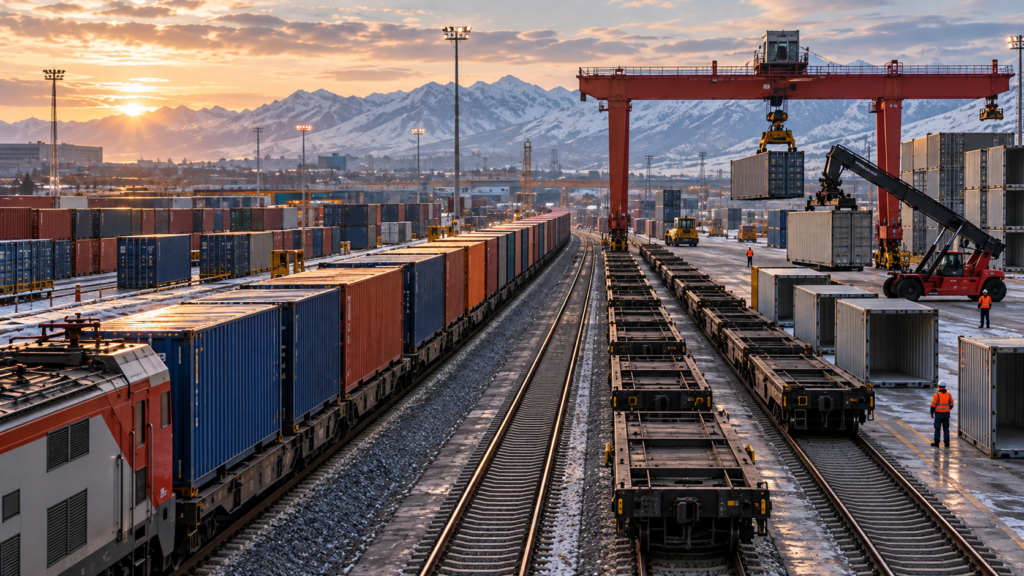
Empty container repositioning is easy to overlook when a rail shipment reaches its destination. But the container’s journey is not necessarily over: it may still need to be reused locally, matched with backhaul cargo or repositioned before the next loaded movement can begin.
If suitable cargo is available for the next movement, the container can be used productively again. If not, it may wait, be reused nearby, be reallocated to another market, or move empty toward a location with stronger future demand. This is the problem behind empty container repositioning: freight economics do not necessarily end when the original cargo is delivered.
For Eurasian rail and intermodal corridors, the issue becomes especially important when freight is much stronger in one direction than the other. A corridor can grow while still facing a return-side equipment problem.
Why the Container’s Journey Does Not End at Delivery
Cargo and equipment follow connected but different cycles. A shipper focuses on moving goods from origin to destination. The operator or equipment manager must also decide what happens to the container after unloading and where it should be positioned for the next useful load.
If compatible demand exists nearby, the box may be reused locally or loaded with backhaul cargo. Otherwise, it may wait or be repositioned. A successful loaded movement can therefore coexist with weak round-trip equipment utilization.
What Is Empty Container Repositioning?
Empty container repositioning is the movement or reallocation of empty containers from locations where equipment is available or in surplus to locations where it is needed for future loaded shipments.
A peer-reviewed Omega review of empty container repositioning in Eurasian intermodal transport treats the issue as a structural network problem connected to trade imbalance and intermodal container flows. The research explains the mechanism; it does not establish current equipment conditions on any particular corridor.
Repositioning is not simply “returning the box home.” Depending on ownership, container type, timing, local demand and network allocation, an unloaded container may be reused locally, held for another load, reallocated regionally, or positioned toward a different market.
Why Backhaul Cargo Matters
Backhaul cargo, also described as return cargo, can make part of the return equipment cycle productive. Instead of moving an empty container toward another demand location, the equipment may carry commercially useful cargo in that direction.
The match still has to work operationally. Return cargo may require a different container type, appear at the wrong time, or terminate in an inconvenient location. More backhaul demand can reduce repositioning pressure without eliminating empty movements.
Cargo Flow and Equipment Flow Are Different Problems
A useful distinction in container logistics is between where goods need to move and where equipment needs to be positioned.
| Concept | What Moves | What Creates Imbalance | Why It Matters |
|---|---|---|---|
| Cargo flow | Loaded goods | Commercial demand differs by origin and destination | Determines where shippers want freight to move |
| Container flow | Container equipment | Boxes accumulate away from future loading demand | Influences where suitable containers are available |
| Wagon/platform flow | Rail rolling equipment | Rail equipment may be positioned away from the next requirement | Container availability alone may not make a rail movement executable |
A strong East-to-West cargo market may continuously send loaded containers toward western terminals while future loading demand for those boxes is stronger elsewhere. Cargo demand and equipment-positioning demand can therefore point in different directions or occur at different times.
How Directional Freight Imbalance Creates Container Pressure
When substantially more freight moves one way, containers can accumulate at some nodes while availability pressure develops elsewhere. Ownership, equipment type, local reuse, timing and network allocation influence the next move.
A network can have many containers overall while still lacking the correct box where the next shipment needs it. Equipment availability is therefore location-specific, time-specific and equipment-type-specific.
Why Traffic Imbalance Does Not Reveal the Empty-Container Rate
Directional traffic data can show that freight demand is uneven, but it cannot by itself tell us how many containers later moved empty.
A westbound-heavy TEU total does not reveal local reuse, ownership, alternative repositioning routes, container type, or the loaded/empty status of later equipment movements. Converting a directional split directly into an empty-return percentage would mix different datasets and overstate what the traffic figures actually show.
What Can Happen After a Container Is Unloaded?
The next step depends on demand, equipment rules and network priorities.
| Situation | Possible Container Outcome | Operational Implication |
|---|---|---|
| Suitable local cargo is ready | Productive local reuse | The box may not need a direct return movement |
| Suitable backhaul cargo exists | Productive return-direction movement | Equipment moves while carrying another load |
| No immediate demand exists | Wait or later allocation | Timing and depot position become relevant |
| Equipment is needed elsewhere | Regional or long-distance repositioning | An empty movement may be required |
| Available box is the wrong type | Equipment remains mismatched to demand | Total container count can hide a type-specific shortage |
Local reuse can reduce an empty leg, but it is not automatic. Ownership, leasing arrangements, cargo compatibility, equipment type, timing and network strategy may restrict reassignment.
Why Container Imbalance Is Not the Same as Wagon Imbalance
A container and the rail equipment carrying it are separate assets. Container imbalance concerns where suitable boxes are positioned. Wagon or platform imbalance concerns where suitable rail rolling equipment is positioned.
The same container can continue through an intermodal chain while the wagon, operator or transport mode changes. A terminal may have suitable containers but insufficient rail platforms for the next movement, or the reverse. Container availability alone therefore does not establish that a rail movement can be executed.
How Empty Repositioning Changes Rail Freight Economics
Empty equipment still uses physical resources. Depending on the network, repositioning may require wagon or platform space, train capacity, truck movement, vessel space, or terminal handling.
Operating models and capacity conditions differ, so an empty box does not necessarily displace a loaded shipment. It still remains part of the equipment cycle even when carrying no revenue-generating cargo.
Three commercial ideas should stay separate. A shipper freight rate is the commercial price offered for a particular shipment. Empty repositioning cost relates to moving equipment toward future demand. Round-trip network economics includes loaded movements, backhaul demand, empty positioning, handling and equipment utilization.
These concepts can influence one another, but they are not the same number. Stronger backhaul may improve utilization without guaranteeing a lower freight rate for every shipper.
The Middle Corridor in 2026: A Live Backhaul Case Study
The Middle Corridor is useful here because return cargo has become an explicit operational concern. At the Black Sea and Caspian Freight Forum on 8 September 2026, Azerbaijan Railways adviser Emil Mammadov said work was underway to attract freight from Europe toward the East and described backhaul as important to the corridor’s long-term development, according to APA’s report from the forum.
This supports a limited conclusion: corridor stakeholders are working to strengthen the weaker return direction. It does not establish empty-return volumes, current equipment availability, or the effect on a particular freight rate.
Readers who need route architecture can use Arta Rail’s Middle Corridor rail freight guide. Here, the corridor is only a current example of the return-trip problem.
What the 80/20 Directional Split Actually Tells Us
For January through August 2026, ADY Express COO Rashad Majidov reported 53,574 TEU on the Middle Corridor: 42,642 TEU East-to-West and 10,932 TEU West-to-East. Report.az’s account of the ADY Express data described the split as approximately 80% versus 20%.
The correct interpretation is that traffic was strongly imbalanced by direction during that period. The figures do not measure the percentage of containers that later returned empty.
| Evidence | What It Supports | What It Does Not Prove |
|---|---|---|
| 80/20 directional TEU split | Strong directional traffic imbalance during the reported period | Percentage of containers physically returning empty |
| Stakeholder focus on return cargo | Backhaul is a current corridor priority | Guaranteed container shortage or rate reduction |
| Corridor infrastructure | Equipment can potentially move through the network | Current capacity for a specific box or shipment |
| Documented freight movement | A route or service has been used | Equipment availability for the next movement |
Subtracting 20 from 80 and declaring a 60% empty-return rate would be invalid. The data does not reveal local reuse, ownership, alternative repositioning, or subsequent loaded/empty movements.
Where Terminal and Intermodal Interfaces Enter the Equipment Cycle
In a multimodal corridor, maritime and terminal interfaces can affect how quickly loaded or empty equipment circulates. Containers may require handling and transport resources at those interfaces whether they carry cargo or are being repositioned.
These constraints are separate from the underlying demand imbalance: demand shapes where cargo wants to move, while terminal and modal interfaces shape how the network responds. Arta Rail’s multimodal transport guide provides broader background on rail, road and sea interfaces.
The Proposed Container Return Cycle
A practical way to visualize the problem is as a proposed Container Return Cycle:
Loaded movement → delivery and unloading → container becomes available → suitable cargo available? → productive reuse/backhaul OR wait/reallocate/empty reposition → next loaded movement.
This is an editorial framework, not an industry standard or proprietary Arta Rail methodology. No immediate backhaul does not automatically trigger an empty movement back to the original loading point.
The next decision depends on ownership, container type, timing and network needs. Backhaul improves the cycle only when cargo and equipment requirements match.
Hypothetical Scenario: The Cargo Arrives, but the Cycle Continues
A loaded container moves East-to-West and is unloaded successfully, but no suitable return cargo is immediately available. The equipment manager may wait for demand, reuse the box locally, reposition it to another regional node, or move it empty toward a stronger loading market.
If compatible West-to-East cargo later becomes available nearby, a productive backhaul may become possible. Delivery ends the cargo movement, but not necessarily the equipment decision.
What This Means for Shippers and Freight Forwarders
Most cargo owners do not manage an operator’s entire equipment fleet, yet imbalance can still affect shipment planning. Availability and commercial conditions can differ by direction, location, equipment type and timing.
For recurring containerized freight, useful questions include whether the required equipment is positioned at origin, whether suitable rail or intermodal capacity exists when needed, and whether terminal interfaces fit the shipment. The practical lesson is not that a shipper should solve empty repositioning personally; it is that cargo flow and equipment flow both have to support a repeatable transport plan.
Conclusion: Freight Economics Continue After Delivery
A corridor can move loaded containers successfully in one direction and still face an equipment problem after unloading. Empty container repositioning is best understood as part of a wider equipment cycle, not simply as an empty trip back to where the box started.
Backhaul cargo can make some return-direction movements productive, but efficient equipment use still depends on having the right container in the right place, at the right time, for the next compatible load.
For companies planning containerized rail or multimodal shipments across Eurasia, the useful question is not only where the cargo can move. It is whether the route, equipment and complete transport chain can support the movement under current conditions. Once those requirements are defined, companies can explore Arta Rail’s freight services for shipment-specific discussion.