
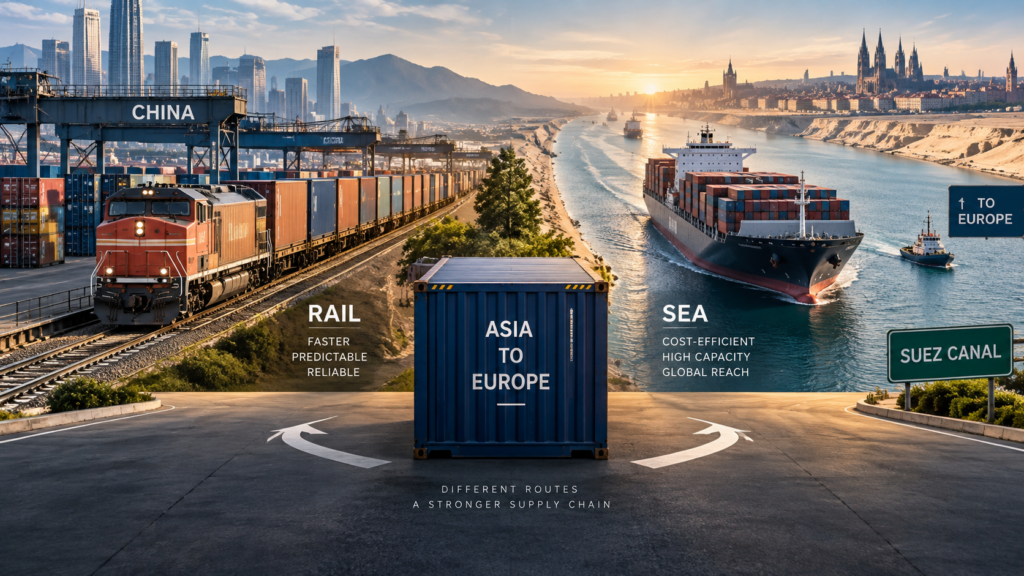
More Asia–Europe container services are returning to the Suez Canal. That matters because prolonged diversions around the Cape of Good Hope had strengthened the case for some overland alternatives.
But it does not settle the China Europe rail vs sea freight decision.
As of September 2026, the return remains uneven. Maersk and Hapag-Lloyd have begun a staged expansion of trans-Suez routing across additional Gemini services, MSC continues to describe its restoration as partial and service-specific, and CMA CGM still uses different routings on some eastbound and westbound services.
So Suez is becoming more commercially relevant again, but that is not the same as saying every Asia–Europe ocean service has returned to one stable routing pattern.
During prolonged Red Sea disruption, rail could gain value partly because ocean routes became longer or less straightforward. As that temporary disadvantage shrinks on some services, rail has to justify itself through the actual shipment: origin, destination, value of time, inventory exposure, terminal access, handling requirements and current service availability.
The useful question is no longer simply whether rail is faster.
It is:
When sea becomes more competitive again, which shipments still gain enough value from rail to justify choosing it?
What Actually Changes as More Ocean Services Return to Suez?
Using Suez rather than routing around the Cape can shorten the maritime main haul for services that make the change.
That strengthens the ocean side of the comparison.
Yet the effect remains service-specific. A carrier announcement may apply to selected loops, implementation can begin on different sailing dates, and contingency plans may remain in place if operational or security conditions change.
You do not book “the return of Suez.” You book a particular service for a particular origin, destination and shipment window.
What Does “Suez Is Returning” Actually Prove?
| Evidence Level | What It Proves | What It Does Not Prove |
|---|---|---|
| Canal is available | The maritime route can physically be used | Your carrier or service uses it |
| Carrier announces a return | A routing change is planned | Every sailing already follows the new route |
| Selected service resumes | A named service uses Suez | The wider network has normalized |
| Recurring passages occur | The routing is being used operationally | Every schedule is stable |
| Network schedules stabilize | Suez is broadly embedded again | Your shipment has space on a suitable sailing |
| Shipment has a viable sailing | A relevant current service exists | Future availability is guaranteed |
This is a practical decision framework for interpreting evidence, not an official carrier or Suez Canal Authority methodology.
Suez Traffic Is Returning — But That Is Not Full Normalization
The distinction between a route becoming more available and the market becoming fully normalized matters because freight decisions happen at service level.
Current carrier statements still include operational and security caveats. Some services have resumed Suez routing, others remain on alternative routings, and implementation is not identical across carriers or directions.
A shipper should therefore verify the actual service rather than infer availability from a market headline.
Rail requires the same discipline.
A Eurasian rail corridor can exist, carry regular freight and still fail to match a specific shipment because the required departure, equipment, capacity, terminal chain or compliance conditions do not align.
Both modes therefore need to pass a shipment-level feasibility test.
Rail vs Sea: Compare the Whole Logistics Chain, Not Headline Transit Times
Many rail-versus-sea comparisons begin with two numbers.
One is a rail transit time. The other is an ocean transit time.
The problem is that those numbers often measure different parts of the journey.
A rail figure may describe terminal-to-terminal movement. An ocean figure may represent port-to-port sailing. Another source may quote a full door-to-door lead time.
Those are not equivalent comparisons.
A useful China–Europe analysis should model both chains from the real loading point to the final consignee.
Rail chain: Chinese origin → first mile → rail terminal → Eurasian rail movement → border and terminal interfaces → European rail terminal → final delivery.
Sea chain: Chinese origin → port pre-carriage → Chinese seaport → ocean service → Suez or Cape routing → European port → final inland delivery.
Rail vs Sea: What Are You Actually Comparing?
| Metric | Rail | Sea | Common Comparison Error |
|---|---|---|---|
| Main-haul time | Rail-network movement | Ocean sailing | Treating either as total lead time |
| Origin access | Factory to rail terminal | Factory to seaport | Ignoring pre-carriage |
| Destination access | Rail terminal to consignee | Port to consignee | Treating Europe as one delivery point |
| Interfaces | Borders and terminals where relevant | Ports, cut-offs and possible transshipment | Counting only the line-haul stage |
| Schedule | Relevant train or service departure | Relevant vessel rotation | Using best-case advertised timing |
| Cost scope | Rail + inland + terminal + inventory effects | Ocean + inland + port + inventory effects | Comparing only headline freight rates |
The core rule is simple:
Compare origin-to-destination with origin-to-destination.
Otherwise, even individually accurate numbers can support the wrong commercial decision.
When Rail Still Creates Value
Rail can remain valuable when time has meaningful economic value to the shipment.
Industrial components, electronics, machinery parts and seasonal goods may become time-sensitive when additional transit days increase inventory exposure or disrupt replenishment.
The important question is whether the time advantage survives the complete logistics chain.
A fast international rail leg has less value if the shipment requires a long first-mile move to reach the departure terminal, waits for the appropriate service or faces an inefficient final leg at destination.
When the entire chain preserves the advantage, shorter lead time can reduce in-transit inventory and working-capital exposure.
Rail becomes more interesting when the delivery window has economic value, inventory in transit matters, terminal access is practical, the cargo fits the service and the selected route is operationally usable.
No single factor decides the mode by itself.
When Sea Becomes Harder to Beat
Sea becomes particularly strong when transport efficiency matters more than speed and the shipment connects naturally to the port network.
A time-flexible shipment with efficient access to a Chinese seaport and a European destination near a major port can create a strong ocean proposition.
The return of Suez routing strengthens that case on services that can avoid the longer Cape route.
Still, the main-haul ocean freight rate is not the full logistics bill.
The shipment may still need substantial inland transport before departure and after European discharge, while inventory remains tied up throughout the journey.
Sea can therefore become the stronger option without being universally cheaper in total logistics terms.
Likewise, rail can shorten the international leg without automatically becoming the better end-to-end solution.
Why the Chinese Origin Can Change the Decision
China is not one loading point.
A factory close to Shanghai, Ningbo or Shenzhen interacts with the maritime network differently from a production site deep inland.
For a coastal origin, port access may be straightforward. An inland factory may first require a substantial road move toward the coast. Rail can face the reverse problem.
Being inland does not automatically make a shipment rail-friendly. The factory still needs practical access to a suitable terminal, an appropriate service, equipment availability and a viable onward route.
The first useful question is therefore:
How does this factory connect to each mode?
Where a reader needs deeper detail on Chinese inland rail gateways and regional rail flows, the dedicated China–Central Asia rail freight guide should carry that route-specific discussion.
Why the Final European Destination Matters Just as Much
The same logic applies at the other end.
A consignee close to a major European seaport can give ocean freight a strong final-mile position.
An inland manufacturing site near an appropriate rail terminal produces a different geometry.
This is why a Shanghai-to-Rotterdam comparison cannot represent every China–Europe shipment.
A coastal-origin/coastal-destination shipment and an inland-origin/inland-destination shipment may reach different mode decisions even when the cargo itself is similar.
Cargo Value, Inventory and the Real Cost of Time
Transport invoices show freight charges.
Supply chains experience a wider cost.
Goods in transit tie up capital. Longer replenishment cycles can require more inventory. A delayed production input can create consequences that do not exist for a low-value, time-flexible shipment.
That is why total logistics cost can matter more than the lowest line-haul quote.
A useful mode evaluation asks:
- how much value remains tied up during transit;
- how flexible the delivery window is;
- whether longer lead time requires additional inventory;
- whether the shipment feeds a production or replenishment cycle;
- how much first- and last-mile transport each mode requires.
These questions do not automatically favor rail.
They determine how valuable time is for that shipment.
Which Shipment Characteristics Change the Rail-vs-Sea Decision?
| Shipment Variable | Rail May Gain Value When… | Sea May Gain Value When… | Must Be Verified |
|---|---|---|---|
| Cargo value | Time in transit has meaningful inventory impact | Additional inventory time has limited impact | Cargo value and financing context |
| Delivery window | Earlier arrival has operational value | Lead time is flexible | Required delivery date |
| Shipment profile | Size and frequency fit available rail service | Volume, equipment and sailing options align efficiently with ocean service | Current booking conditions |
| Chinese origin | Rail-terminal access is efficient | Port access is efficient | First-mile cost and timing |
| European destination | Rail-terminal distribution fits the consignee | Port-based distribution is more efficient | Final delivery chain |
| Frequency | Rail departures align with replenishment needs | Ocean schedules align better with demand | Current service pattern |
| Handling | Rail chain reduces problematic interfaces | Ocean chain is operationally simpler | Actual transfer plan |
| Compliance | Selected rail route is usable for cargo and parties | Ocean route avoids relevant constraints | Current rules and carrier policies |
There is deliberately no winner column.
The stronger option emerges only after the shipment is defined.
Which China–Europe Rail Architecture Is Actually Available?
Rail is not one route.
China–Europe freight can use established Eurasian land networks, while the Middle Corridor provides a separate Trans-Caspian architecture.
Those options involve different borders, terminals, transfer points, operating dependencies and compliance considerations.
The detailed Trans-Caspian chain belongs in the dedicated Middle Corridor rail freight guide rather than in this mode-selection article.
Some Eurasian rail options can also involve Russia or Belarus. In those cases, feasibility may depend on cargo type, counterparties, applicable trade controls, carrier policy and current rules.
The operational principle is enough:
An existing rail corridor is not the same thing as an executable shipment.
A Hypothetical Inland China → Inland Europe Shipment
Consider a hypothetical manufacturer moving high-value industrial components from an inland Chinese production site to an inland European factory.
The shipment is containerized, and a late arrival could affect production planning.
Under a rail option, the cargo must first reach a suitable departure terminal. It then needs a current Eurasian service, workable interfaces and practical final delivery from the European arrival terminal.
Under a sea option, the same shipment moves to a Chinese seaport, joins a suitable Asia–Europe sailing, reaches a European port and completes the inland leg.
As more services return to Suez, the maritime option improves, but the main haul still cannot decide the mode by itself.
If rail saves time internationally but loses much of that advantage through poor terminal access, its business case weakens.
If sea has the lower transport rate but keeps a high-value production component in transit for materially longer, the freight-rate difference may not capture the full economic result.
The relevant comparison remains the complete shipment.
A Practical China–Europe Mode Decision Stack
A useful sequence is:
Cargo profile → exact Chinese origin → final European destination → shipment size and frequency → value of time → rail-terminal access → seaport access → current sea service → current rail service → handling complexity → total logistics cost → shipment feasibility
This is a practical decision framework, not an official industry standard.
There is little value comparing rates before both modes have passed the basic feasibility test.
What Should Be Verified Before Booking?
Before choosing rail or sea, verify the variables that can change in real time:
- exact loading location;
- final delivery point;
- cargo description and value;
- shipment size and equipment;
- target shipment window;
- required delivery window;
- first-mile access;
- final-mile arrangement;
- current rail service;
- current ocean routing;
- handling requirements;
- route-specific compliance;
- comparable quotation scope.
A rail quote and an ocean quote only become useful comparison tools when they cover equivalent shipment boundaries.
Conclusion: Suez Changes the Equation, Not the Need for Shipment-Level Analysis
The return of more Asia–Europe services to Suez makes ocean freight more competitive again.
That removes part of the temporary advantage rail gained from widespread Cape diversion, but it does not create a universal winner.
Rail can remain attractive when time, inland geography, inventory exposure and terminal access support it. Sea becomes harder to beat when transport efficiency, port access and schedule flexibility dominate.
The correct choice emerges only after both modes are built around the same shipment.
If the Chinese origin, European destination, cargo profile and shipment window are already known, share the shipment details for an initial routing review.