
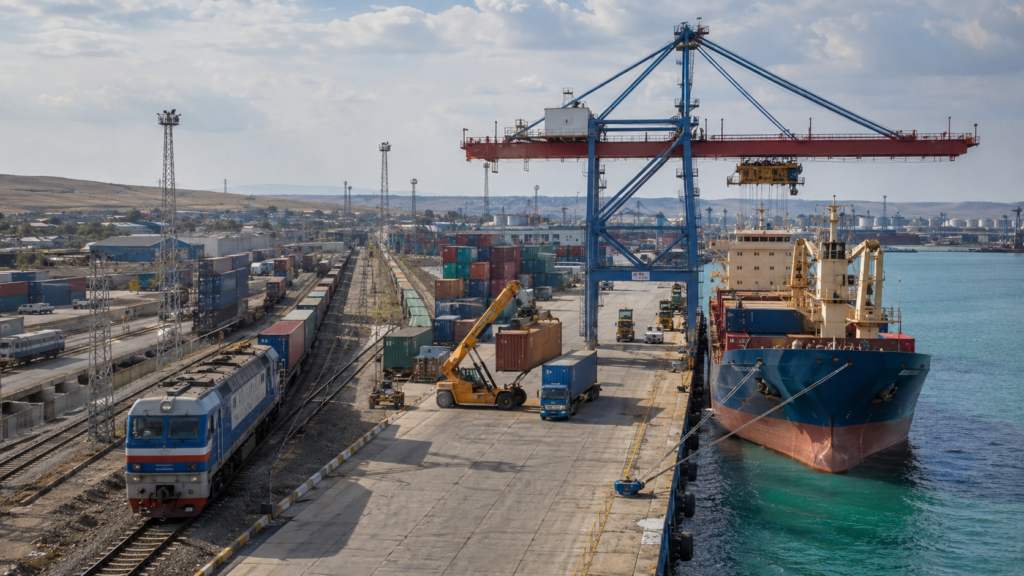
A manufacturer moving containerized cargo from an inland Chinese factory to a consignee in Türkiye may look at the Middle Corridor and see a relatively straightforward westbound rail connection. The route crosses Kazakhstan, reaches the Caspian, continues through Azerbaijan and Georgia, and can connect onward toward Türkiye and European markets.
The shipment itself is more complicated than the map. China and Kazakhstan operate different rail gauges, the Caspian introduces port and maritime operations, and another rail-network interface can become relevant before Türkiye. The factory may also need a road First Mile before international rail begins, while final delivery can extend beyond the destination rail terminal.
For that reason, Middle Corridor rail freight should be evaluated as an origin-to-destination shipment architecture, not simply as a railway line between China and Europe.
What Does “Middle Corridor Rail Freight” Actually Mean?
The Trans-Caspian International Transport Route connects China and Central Asia with the South Caucasus and onward European markets. Its core architecture passes through Kazakhstan, crosses the Caspian Sea, enters Azerbaijan and Georgia, and can continue west toward Türkiye or other European connections.
The important word for shipment planning is multimodal. Azerbaijan’s official East–West Corridor overview describes the Middle Corridor as integrating rail, maritime and road infrastructure. It also identifies the Baku–Tbilisi–Kars railway and Georgian Black Sea connections as western routing options.
The core Trans-Caspian architecture can therefore be understood conceptually as:
Rail → Port → Caspian Sea → Port → Rail
Road transport may then provide the First Mile, Last Mile or both.
“Middle Corridor” is the clearest commercial term for readers, while Trans-Caspian International Transport Route (TITR) is useful when referring to the formal route and its institutional framework. TRACECA relates to wider regional transport cooperation, but it should not simply be treated as another name for TITR.
Why the Caspian Sea Changes the Shipment Architecture
The Caspian Sea is not a minor interruption in an otherwise continuous railway. Instead, it introduces an additional logistics stage that can determine whether the route works commercially.
For westbound cargo crossing Kazakhstan, the journey must connect with a suitable Caspian port operation before entering the maritime segment. After reaching Azerbaijan, the shipment then needs to reconnect with inland transport. As a result, rail arrival, terminal handling, maritime availability and onward rail must form a workable sequence.
Middle Corridor evidence can be assessed through six levels of confidence:
- Infrastructure Exists
- A Train or Shipment Has Operated
- Recurring Corridor Activity Exists
- Commercial Service Is Available
- Required Capacity, Equipment and Vessel Space Are Available
- The Specific Shipment Is Feasible
Railway investment can demonstrate infrastructure development, while a completed train movement confirms that the corridor has been used. Neither type of evidence, on its own, establishes that the equipment, maritime space or commercial capacity required for another shipment is currently available.
This distinction is particularly relevant in 2026. In February, the World Bank approved support intended to mobilize major financing for rail connectivity along Kazakhstan’s section of the Trans-Caspian route. The project strengthens the corridor’s long-term infrastructure significance, but infrastructure investment remains a different evidence level from shipment-specific availability.
CAREC also describes the Middle Corridor as fundamentally multimodal and identifies Caspian maritime capacity among its structural constraints.
When Can the Middle Corridor Make Sense for a Shipment?
There is no universal cargo value, shipment size or delivery requirement that automatically makes the Middle Corridor the right choice. Its suitability depends on whether the entire operating architecture fits the shipment.
| Shipment Variable | Why It Changes Middle Corridor Feasibility | Required Information |
|---|---|---|
| Cargo profile | Handling and acceptance requirements can affect terminal and service suitability | Cargo description, form and packaging |
| Shipment scale | Volume and frequency affect equipment and service planning | Weight, volume and frequency |
| Chinese origin | First Mile and departure-terminal access affect route economics | Exact loading point |
| Final destination | Türkiye or Europe is not one logistics endpoint | Exact destination and unloading point |
| Container/equipment | Interfaces depend partly on the loading unit and equipment | Container or equipment requirements |
| Current service | Physical infrastructure does not establish bookability | Current rail and maritime arrangements |
| First Mile | Factory access may alter the apparently attractive corridor | Origin-to-terminal plan |
| Last Mile | Final delivery can change cost and route selection | Terminal-to-consignee plan |
Exact Origin and Final Destination
China is not a loading point.
Cargo produced at an inland factory may first require trucking, positioning or consolidation to reach an international rail departure terminal. The origin can also influence which China–Kazakhstan gateway is relevant.
For readers who need deeper gateway analysis, Arta Rail separately explains how China–Central Asia rail gateways change route feasibility. The Middle Corridor article only needs enough gateway detail to explain the shipment architecture.
The same logic applies at the western end. “Türkiye” and “Europe” are markets, not delivery points. The final city, rail-terminal access, unloading arrangements and road Last Mile can materially affect the route decision.
Cargo, Container and Shipment Scale
Containerized freight is central to many documented Middle Corridor movements, but the presence of a container does not establish route suitability.
Cargo characteristics still need to align with the handling environment, loading unit, terminal arrangements and commercially available service. Handling-sensitive cargo can also be affected differently by repeated interfaces than a conventional containerized industrial shipment.
Shipment frequency matters as well. A one-off movement and a recurring flow can create different equipment, service and coordination requirements.
How Does the Middle Corridor Route Work?
The core architecture supported by the completed research is:
China → Kazakhstan → Caspian Sea → Azerbaijan → Georgia → Türkiye / Europe
This architecture is established and freight activity is documented, but the corridor should not be interpreted as one fixed train service with one permanent terminal sequence.
The China–Kazakhstan Rail Interface
China predominantly operates on 1,435-mm standard gauge, while Kazakhstan predominantly uses 1,520-mm gauge.
That difference creates an operational interface at the China–Kazakhstan border. Alashankou/Dostyk and Khorgos/Altynkol are important gateway pairs, but the relevant point here is the network transition rather than a universal claim that one gateway is preferable. Arta Rail’s existing China–Central Asia content already owns the broader gateway-comparison intent.
A gauge transition does not prescribe one universal procedure. Depending on the loading unit, equipment, terminal and service design, the shipment may involve container transfer, wagon-related procedures or other terminal operations.
Kazakhstan Rail to Aktau or Kuryk
Once inside Kazakhstan’s 1,520-mm network, westbound cargo can continue toward the Caspian.
Aktau and Kuryk are both relevant Trans-Caspian nodes, but they should not be treated as interchangeable.
Aktau has continued to receive infrastructure attention in 2026, including dredging work reported by Kazakhstan’s Ministry of Transport. That supports its continuing importance to the corridor; it does not establish shipment-specific port or maritime availability.
Kuryk has also received infrastructure upgrades. Kazakhstan’s Ministry of Transport reports completion of modernization work on transfer bridges and documents substantial rail and road cargo handling in the first half of 2026. The evidence confirms active port operations, not a guaranteed sailing or available vessel slot for a particular shipment.
Which port fits a shipment depends on the actual commercial service, equipment, maritime arrangement and westbound connection.
Crossing the Caspian Sea
The Caspian stage is where “rail freight” most clearly stops meaning uninterrupted train movement.
Cargo reaches a port, passes through terminal operations, moves across the sea and re-enters a land transport network on the Azerbaijan side. Official corridor descriptions explicitly include this maritime stage. Transit Azerbaijan
The operational implication is important: an available rail movement into the port does not automatically provide a commercially aligned maritime movement out of it. The rail, terminal, vessel and onward rail stages have to work together.
Baku / Alat and Westbound Rail
On the western side of the Caspian, the Port of Baku at Alat is a major multimodal logistics interface. Azerbaijan’s transit authority describes the port as an important segment of TITR and notes its integration with rail and road networks.
Alat is still an intermediate logistics node rather than the final destination. Cargo must reconnect to the appropriate westbound network and continue toward its actual consignee.
Georgia, BTK and Türkiye
For cargo moving toward Türkiye, the Baku–Tbilisi–Kars railway can form an important western connection.
A second rail-system interface becomes relevant at Akhalkalaki, where the 1,520-mm broad-gauge system connects with the 1,435-mm standard-gauge line toward Kars. CAREC identifies Akhalkalaki as the gauge-interchange location and documents container transfer between broad- and standard-gauge platform wagons.
BTK is an important Middle Corridor component, but it should not be treated as mandatory for every western movement. The final destination and current operating architecture determine whether a Türkiye rail continuation or another western branch is relevant.
Why Rail Gauge and Transfer Operations Matter
A Middle Corridor shipment can therefore encounter more than one network transition: first between China and Kazakhstan, and potentially again between the broad-gauge Caucasus system and Türkiye.
This creates a useful distinction for cargo owners:
Container continuity is not wagon continuity.
A container can remain the same loading unit while its wagon changes. It can also pass through a port, maritime stage and another rail system without ever implying that one wagon travelled continuously from China to the destination.
| Operational Interface | Structural Role | Shipment Implication | Current Validation Required |
|---|---|---|---|
| China–Kazakhstan | 1,435 / 1,520-mm rail interface | Transfer or wagon-related handling may apply | Yes |
| Kazakhstan inland rail | East–west rail movement | Rail service must connect with Caspian architecture | Yes |
| Aktau / Kuryk | Rail-to-maritime interface | Port selection depends on actual service design | Yes |
| Caspian crossing | Maritime stage | Maritime availability and synchronization matter | Yes |
| Baku / Alat | Maritime-to-land interface | Cargo must reconnect to westbound transport | Yes |
| Georgia / Türkiye | 1,520 / 1,435-mm interface where applicable | Network/terminal procedures must be aligned | Yes |
The table identifies operational interfaces; it does not prescribe one universal transfer procedure for each location.
Infrastructure, Corridor Activity and Commercial Service Are Different
The Middle Corridor is not merely a proposed infrastructure project. Freight movements are documented.
On 8 May 2026, KTZ Express reported a Türkiye-to-China container train moving through the Trans-Caspian route via Aktau and Altynkol. The reported train consisted of 50 forty-foot containers. That provides strong evidence of current corridor usage.
The correct inference is limited: the corridor supported that documented movement.
It does not automatically establish westbound space for a different cargo, current vessel availability, matching equipment, terminal acceptance or the timing required by another shipper. Those belong further up the evidence ladder.
How First Mile and Last Mile Change the Decision
Headline corridor performance describes only part of the shipment.
A factory located far from a suitable Chinese departure terminal may require additional road movement and handling before international rail begins. Those operations can change both the economics and practical appeal of the route.
The same issue appears at destination. A container may reach Türkiye successfully by rail and still require road transport to the consignee.
That road leg does not make the rail architecture unsuccessful. It shows why the relevant commercial comparison is loading point to final delivery, not China to Türkiye in the abstract.
When Should the Middle Corridor Be Compared with Other Routes?
The Middle Corridor should be compared with alternatives only after those alternatives have been defined on the same shipment scope.
Depending on origin and destination, a shipper may reasonably compare the Trans-Caspian architecture with ocean freight, a northern Eurasian rail route or another overland architecture.
Where an Iran-linked China–Europe alternative is relevant, Arta Rail separately examines how the Iran-based China–Europe route differs from the Trans-Caspian architecture. That topic remains separate from the Middle Corridor’s own search ownership.
The comparison should not start with “Which corridor is faster?” or “Which rate is lower?” A useful evaluation first asks whether the origin, equipment, interfaces, ports, destination and current commercial services form an executable route.
Freight Rate vs Total Logistics Cost
A quoted Middle Corridor rate rarely represents every cost between factory and consignee.
| Cost Component | When It Applies | Why It Matters |
|---|---|---|
| China First Mile | Factory is outside the departure terminal | Can materially alter corridor economics |
| Origin terminal | Cargo requires acceptance, handling or consolidation | Adds a separate operating stage |
| China–Kazakhstan interface | Rail networks transition | Interface handling may add cost |
| Kazakhstan rail | Cargo moves west through Kazakhstan | Main inland rail component |
| Aktau/Kuryk terminal | Cargo transfers toward the Caspian | Port handling becomes part of delivered cost |
| Caspian maritime leg | Core Trans-Caspian architecture is used | Separate transport stage |
| Baku/Alat terminal | Cargo enters western Caspian network | Discharge and reconnection may apply |
| Azerbaijan/Georgia rail | Cargo moves west inland | Continued main-haul component |
| Georgia/Türkiye interface | Türkiye rail architecture is used | Network-interface operations may apply |
| Destination terminal | Main international movement ends | Arrival handling can affect final scope |
| Last Mile | Consignee is beyond the rail terminal | Determines final delivered cost |
This is why route feasibility should be established before rate optimization.
A lower quoted main-haul rate cannot be compared meaningfully with a door-to-door alternative unless both quotations cover comparable origin-to-destination scopes.
Proposed Middle Corridor Route-Before-Rate Framework
For editorial and shipment-planning purposes, the following Proposed Middle Corridor Route-Before-Rate Framework provides a practical sequence:
- Define the cargo profile.
- Confirm shipment scale and frequency.
- Confirm the exact loading point.
- Confirm the exact final destination.
- Assess origin rail access.
- Define container and equipment requirements.
- Build the candidate Middle Corridor architecture.
- Validate the China–Kazakhstan network interface.
- Determine the relevant Kazakhstan port architecture.
- Assess the Caspian transfer requirement.
- Confirm the Baku/Alat interface.
- Assess the relevant Georgia/Türkiye or western continuation.
- Integrate First Mile and Last Mile.
- Validate current rail and maritime service availability.
- Compare total logistics cost.
- Confirm the complete operational plan before booking.
This is a proposed editorial decision framework, not a claim that Arta Rail operates a proprietary methodology.
The sequence matters because a commercially non-executable route should be eliminated before an attractive freight rate becomes the deciding factor.
Hypothetical Shipment: Inland China to Türkiye
Consider a hypothetical containerized industrial shipment from an inland Chinese factory to a consignee in Türkiye.
The initial map view suggests a relatively simple westbound railway connection. In practice, the factory first needs a workable link to an international departure terminal. The container then enters the China–Kazakhstan rail interface and moves west across Kazakhstan.
At the Caspian, the architecture changes again. Cargo must enter the relevant Kazakhstan port operation, complete the maritime stage, reconnect with the western network at Baku/Alat and continue through the Caucasus.
If the shipment moves toward Türkiye through BTK, it also encounters the broad-gauge-to-standard-gauge interface around Akhalkalaki. Final delivery may still require trucking after the long-distance rail segment ends.
None of those interfaces proves that the Middle Corridor is a poor choice. They explain why a route that looks continuous at continental scale still requires shipment-level planning.
What Information Is Needed Before Route Evaluation?
A meaningful route evaluation should begin with shipment information rather than a generic request for the Middle Corridor price.
Useful inputs include:
- cargo description and form;
- packaging;
- weight and volume;
- container or equipment requirement, if known;
- exact loading point;
- exact final destination and unloading point;
- shipment frequency;
- preferred timing;
- special handling requirements;
- Incoterm where relevant.
The exact origin and destination are especially important because route comparisons should cover equivalent commercial scopes.
What Must Be Confirmed Before Booking?
Even when the structural architecture makes sense, the required operating stages still need current confirmation.
Depending on the shipment, that can include the departure service, China–Kazakhstan interface, Kazakhstan rail movement, relevant Caspian port, maritime arrangement, Azerbaijan-side connection, western rail continuation, equipment and final delivery.
Corridor maps and historical movements answer whether infrastructure and activity exist. Booking requires higher evidence levels: commercially available services and the specific equipment or capacity needed by the shipment.
Planning the Next Step
Before choosing the Middle Corridor, the shipment should be defined clearly enough to evaluate the complete route from origin to final delivery. Cargo type, weight or volume, exact loading point, destination, equipment requirements, and loading or unloading conditions can all affect whether the Trans-Caspian architecture is workable.
Once those details are available, they can be shared with Arta Rail for route and commercial evaluation. The next step is not simply to compare a headline corridor rate, but to confirm whether the required rail, port, maritime, terminal, and final-delivery stages can be aligned for the actual shipment.