International Rail Freight: How Global Rail Shipping Works and When Companies Should Choose It

International rail freight is no longer evaluated only as an alternative transportation method. For companies managing global supply chains, choosing rail means evaluating whether a specific route, cargo type, and operational structure can support their business requirements.
Many businesses begin transport decisions with simple comparisons: Which option costs less? Which route is shorter? Which method is faster?
However, professional logistics planning requires a broader perspective.
A lower freight rate does not always create the lowest total logistics cost.
A shorter route does not always provide the most reliable supply chain solution.
And the existence of railway infrastructure does not automatically mean that rail is the right choice.
Available transport option ≠ Suitable transport solution
The key question for exporters, importers, manufacturers, and logistics managers is not:
“Can this shipment move by rail?”
The more important question is:
“Does international rail freight match the cargo requirements, route conditions, delivery priorities, and supply chain objectives?”
What Is International Rail Freight?
International rail freight refers to the movement of goods between countries through connected railway networks and cross-border logistics infrastructure.
Unlike domestic rail transportation, international rail freight involves multiple operational stages that must work together. A successful shipment depends not only on train movement but also on terminal coordination, border procedures, documentation, and connections with other transport modes.
A typical international rail freight journey includes several operational stages:
| Stage | Operational Purpose |
|---|---|
| Cargo preparation | Ensuring goods are suitable for international transportation |
| Origin transport | Moving cargo from the supplier or factory to the rail terminal |
| Terminal operations | Handling containers and preparing shipment movement |
| International rail movement | Transporting cargo through connected railway networks |
| Border operations | Managing customs, documentation, and cross-border procedures |
| Final delivery | Connecting the shipment to the destination location |
This process highlights an important distinction:
Rail transportation is not only about moving cargo by train; it is about managing a complete international logistics chain.
Why International Rail Freight Requires More Than a Cost Comparison
One of the most common mistakes in transportation planning is evaluating methods based on a single factor.
Companies may focus on the initial freight price while overlooking operational factors that influence the total performance of the shipment.
For example, a manufacturer exporting industrial equipment to Central Asia may need to evaluate more than the existence of a railway route. The company must consider cargo characteristics, available rail connections, border conditions, terminal accessibility, and the possibility of combining rail with road transportation.
A professional evaluation can be structured through a simple decision framework:
Cargo → Route → Corridor → Risk → Delivery
| Evaluation Stage | Main Question |
|---|---|
| Cargo | Is the shipment suitable for rail transportation? |
| Route | Does a practical rail connection exist between origin and destination? |
| Corridor | Does the selected corridor support efficient cross-border movement? |
| Risk | What operational challenges may affect the shipment? |
| Delivery | How will the cargo reach the final destination? |
This approach helps companies move beyond basic price comparisons and evaluate rail freight as part of a complete supply chain strategy.
How International Rail Freight Fits Into Global Supply Chains
Every transportation method has a specific role within international logistics.
Ocean freight is often associated with large-volume international trade, while road transportation provides greater flexibility for direct connections between locations. International rail freight occupies a different position by connecting inland markets, regional corridors, and major logistics networks.
The suitability of rail depends on several operational conditions:
| Evaluation Factor | Why It Matters |
|---|---|
| Cargo characteristics | Determines whether the shipment matches rail capacity and handling requirements |
| Route availability | Defines whether a practical railway connection exists |
| Border conditions | Influences operational continuity and coordination requirements |
| Terminal infrastructure | Affects handling efficiency and connection possibilities |
| Delivery requirements | Determines whether rail timing matches business priorities |
This evaluation approach prevents a common misunderstanding:
Rail is not automatically the best option because it is available.
Instead, rail should be considered when its operational structure aligns with shipment requirements.
For example, a company shipping containerized industrial machinery from China toward Central Asia may evaluate China–Central Asia rail routes by considering cargo volume, border procedures, terminal connections, and final delivery requirements. The decision is not based only on distance; it depends on whether the complete logistics chain can operate effectively.
The Strategic Importance of International Rail Corridors
International rail freight depends heavily on corridor development. A rail corridor is not simply a railway line between two locations; it is a connected system involving infrastructure, terminals, border crossings, and logistics coordination.
For businesses involved in cross-border trade, understanding corridors helps answer practical questions:
Does the route provide reliable connections?
Can the shipment move through required border points?
Can rail integrate with road, sea, or inland logistics networks?
Regional connections such as China–Central Asia rail routes, Eurasian Rail Corridors, and the Iran Railway Network demonstrate how rail freight functions within wider international trade systems.
The effectiveness of a corridor depends on more than geographic distance. Operational readiness, infrastructure capability, and coordination between different logistics actors determine whether a route can support commercial transportation needs.
International Rail Freight Is a Supply Chain Decision
Selecting international rail freight is not simply a choice between rail, road, and sea. It is a decision about designing a transport structure that supports business objectives.
Professional evaluation considers the relationship between:
Cargo requirements
Route feasibility
Operational complexity
Total logistics cost
Supply chain priorities
Rail freight can be suitable for specific cargo types, routes, and commercial requirements. However, it should not be evaluated through general assumptions such as “rail is always cheaper” or “rail is always faster.”
The most effective logistics decisions come from understanding where rail creates value, where limitations exist, and how it can connect with other transportation methods.
The next section will examine the factors that influence international rail freight costs and explain why total logistics cost depends on much more than the basic transportation rate.
International Rail Freight Process: How Global Rail Shipping Works
International rail freight is not simply the movement of cargo by train from one country to another. A successful rail shipment depends on how different logistics stages work together, including cargo preparation, route selection, corridor availability, border operations, and final delivery.
Many companies compare transport methods by looking only at the main transportation segment. However, international rail performance is influenced by the entire supply chain structure.
A railway connection between two regions does not automatically mean it is the right logistics solution.
Rail availability ≠ suitable rail solution
The key question for logistics managers is not:
“Is there a railway route?”
The more important question is:
“Can this route support the cargo requirements, delivery priorities, operational conditions, and supply chain objectives?”
How International Rail Freight Works
International rail freight is a connected process where multiple operational stages must work together. Companies evaluating rail transportation should examine the complete shipment journey rather than focusing only on the rail segment.
A practical evaluation model can be summarized as:
Cargo → Route → Corridor → Risk → Delivery
This framework helps companies understand that international rail freight decisions depend on the relationship between different logistics factors.
Cargo Evaluation: Understanding Shipment Requirements
The first stage of international rail freight planning begins with understanding the cargo itself.
Cargo characteristics influence whether rail transportation is suitable and how the shipment should be planned. Factors such as shipment volume, container requirements, handling conditions, and delivery expectations can affect the final transport decision.
For example, industrial equipment, containerized goods, and planned commercial shipments may require a different evaluation compared with smaller shipments that require maximum flexibility.
A professional logistics decision starts with cargo requirements, not with selecting a transport method first.
Route Assessment: Evaluating the Complete Transport Path
After analyzing cargo requirements, companies must evaluate the available route.
International rail freight routes are not defined only by railway tracks. They include terminals, border crossings, railway networks, and connections with other transportation modes.
A complete route assessment considers:
- Origin connection
- Railway accessibility
- Terminal capability
- Border procedures
- Destination delivery options
For example, a company shipping industrial goods toward Central Asia may need to evaluate regional rail connections, border conditions, and terminal availability before selecting a route.
The existence of infrastructure is only the beginning. The real challenge is determining whether the entire route can support the shipment.
International Rail Corridors and Their Role in Global Trade
International rail freight operates through larger transportation corridors that connect multiple regions.
These corridors combine railway networks, terminals, border points, and logistics connections to create international supply chains.
Important examples include:
| Corridor / Network | Strategic Role |
|---|---|
| China–Central Asia Rail Routes | Connect Asian production centers with regional markets |
| Eurasian Rail Corridors | Support land-based connections between Asia and Europe |
| Iran Railway Network | Provides regional connectivity between different trade routes |
Each corridor has different operational conditions. Factors such as infrastructure, border processes, and connection points influence whether a route is suitable for a specific shipment.
A major logistics mistake is assuming that one corridor works equally well for all cargo types.
The right approach is evaluating the relationship between cargo requirements and corridor capabilities.
Border Operations: A Critical Part of International Rail Transport
Cross-border rail freight involves more complexity than domestic transportation because multiple operational systems must be coordinated.
A shipment may require alignment between railway operators, terminals, customs processes, and logistics partners.
Border operations can influence:
- shipment planning
- documentation requirements
- operational coordination
- route reliability
This is why international rail freight planning cannot stop at identifying a railway route. Companies must understand how the shipment moves through each operational stage.
Final Delivery and Multimodal Integration
Rail freight is often one part of a larger transportation system.
Many international shipments require additional connections before reaching the final destination. This is where multimodal transportation becomes important.
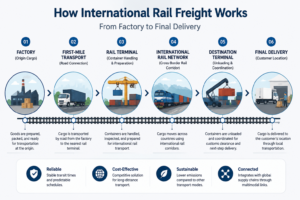
International rail freight follows a structured process connecting cargo origin, terminals, rail corridors, and final delivery points.
For example, a manufacturer exporting industrial equipment may use road transport to move cargo to a rail terminal, rail for the main international section, and another transport method for final delivery.
The objective is not using rail for every stage. The objective is designing a coordinated logistics solution.
Why the International Rail Freight Process Matters
A common mistake in freight planning is evaluating transportation methods only by one factor, such as price or transit time.
Professional evaluation requires understanding how multiple elements interact:
| Decision Area | Key Question |
|---|---|
| Cargo | Is the shipment suitable for rail transportation? |
| Route | Does a practical connection exist between origin and destination? |
| Corridor | Which international route matches operational needs? |
| Risk | What challenges may affect execution? |
| Delivery | How will the cargo reach the final destination? |
This approach helps companies move beyond simple transport comparisons and make decisions based on the complete logistics chain.
International rail freight can be an effective option for specific cargo types and routes, but its success depends on alignment between cargo characteristics, route structure, corridor conditions, operational risks, and final delivery requirements.
The next step in evaluating international rail freight is understanding how costs are created and which operational factors influence the total logistics expense.
International Rail Freight Decision Framework: Building a Practical Transport Strategy
Selecting an international rail freight solution requires more than comparing transport prices or identifying available railway connections. Companies need to understand how different operational factors influence the success of a shipment and whether rail transportation supports their specific supply chain objectives.
A professional decision process should evaluate the complete logistics chain, from cargo characteristics to final delivery requirements.
For this reason, companies can use a structured approach:
Cargo → Route → Corridor → Risk → Delivery
This framework helps logistics teams evaluate international rail freight based on operational reality rather than assumptions.
Cargo: Understanding Whether Rail Fits the Shipment
The first step in evaluating rail freight is understanding the cargo itself.
Every shipment has different requirements. Weight, volume, packaging, container compatibility, handling needs, and delivery priorities influence whether rail transportation is suitable.
For example, industrial equipment moving toward Central Asia may require careful evaluation of cargo dimensions, loading requirements, terminal capabilities, and available transport connections before selecting a rail solution.
The key question is not:
“Can this cargo move by rail?”
The more important question is:
“Can rail provide an effective solution for this cargo within the required supply chain conditions?”
A suitable rail strategy begins with cargo analysis, not with selecting a transport mode first.
Route: Evaluating the Complete Transportation Path
After understanding the cargo, companies need to evaluate the transportation route.
International rail freight is not limited to the railway segment itself. A complete route includes origin facilities, first-mile transportation, rail terminals, border operations, international networks, and final delivery.
A route that appears efficient geographically may still create operational challenges if terminal access, border procedures, or destination connections are limited.
For companies shipping between Asia, Central Asia, Europe, or the Middle East, understanding regional connectivity becomes an important part of planning.
Rail networks, international terminals, and logistics corridors such as China–Central Asia rail routes and Eurasian rail corridors demonstrate how infrastructure availability influences transport decisions.
The practical question is not only:
“Does a railway route exist?”
It is:
“Can this route support the shipment requirements from origin to final destination?”
Corridor: Understanding Regional Logistics Connections
International rail freight operates through different corridors, and each corridor has its own operational characteristics.
A corridor represents more than a line on a map. It includes infrastructure, border procedures, operational coordination, and connections between different transport systems.
For example, companies evaluating routes involving Iran, Central Asia, or Europe may need to consider how railway networks connect with regional trade flows.
The Iran Railway Network can represent an important component in regional connectivity strategies, especially when companies evaluate how different markets can be connected through land-based transportation routes.
However, corridor selection should always be based on shipment requirements rather than assumptions that one route is automatically suitable for every cargo type.
The right corridor depends on:
- Cargo requirements
- Available infrastructure
- Border conditions
- Delivery objectives
- Multimodal opportunities
Risk: Identifying Operational Challenges Before Shipment
Every international logistics solution includes operational considerations.
A professional transport decision requires understanding possible limitations before the shipment begins.
International rail freight may involve factors such as:
- Different infrastructure standards
- Border coordination requirements
- Terminal capacity limitations
- Documentation processes
- Multiple operational partners
These factors do not make rail unsuitable. Instead, they show why international transportation requires detailed planning.
The strongest logistics strategies are not based on choosing a method with no challenges. They are based on identifying risks and creating solutions to manage them.
This approach helps companies move from simple transport selection toward complete supply chain planning.
Delivery: Connecting Rail With the Final Supply Chain
The final stage of transport planning is understanding how rail connects with the complete delivery process.
In many international shipments, rail is part of a multimodal transportation system rather than a standalone solution.
A typical logistics structure may include:
Origin facility
↓
Road connection
↓
Rail terminal
↓
International rail corridor
↓
Destination terminal
↓
Final delivery
This structure shows that successful freight movement depends on coordination between different stages.
Multimodal transportation allows companies to combine different transport methods based on operational needs. Road transportation may provide local flexibility, while rail may support the main international movement between regions.
The objective is not selecting one method for every shipment.
The objective is designing a transport chain that matches the cargo, route, and business requirements.
A Practical Approach to International Rail Freight Decisions
International rail freight decisions become more effective when companies evaluate the complete picture.
Instead of asking:
“Is rail the cheapest or fastest option?”
companies should ask:
“Does this transport solution match our cargo, route, corridor, risk profile, and delivery requirements?”
This approach creates better alignment between transportation decisions and supply chain objectives.
Arta Rail approaches international rail freight from this broader perspective by focusing on route evaluation, regional connectivity, multimodal planning, and operational requirements.
The purpose is not to present rail as a universal solution.
Rail freight can be a suitable option for specific cargo types, routes, and supply chain strategies when the operational conditions support it.
A successful international freight decision depends on understanding the relationship between cargo, infrastructure, corridors, and delivery requirements.
By evaluating these elements together, companies can create more informed transportation strategies and select solutions based on real logistics conditions rather than simple comparisons.
Final Conclusion: Making Better International Rail Freight Decisions
Choosing international rail freight requires more than comparing transport methods. Companies need to evaluate whether a solution matches their cargo, route, corridor, operational risks, and delivery requirements.
The most effective approach is not finding one transport method that works for every shipment, but designing a logistics strategy based on real supply chain conditions.
By considering:
Cargo → Route → Corridor → Risk → Delivery
businesses can make more informed freight decisions and better understand where rail, road, sea, or multimodal transportation creates the most value.
Arta Rail supports this approach by helping companies evaluate international rail connections, regional corridors, and multimodal transport possibilities based on operational requirements.