Rail vs Road Freight: Which Is More Cost‑Effective, Faster, and Sustainable in 2026?
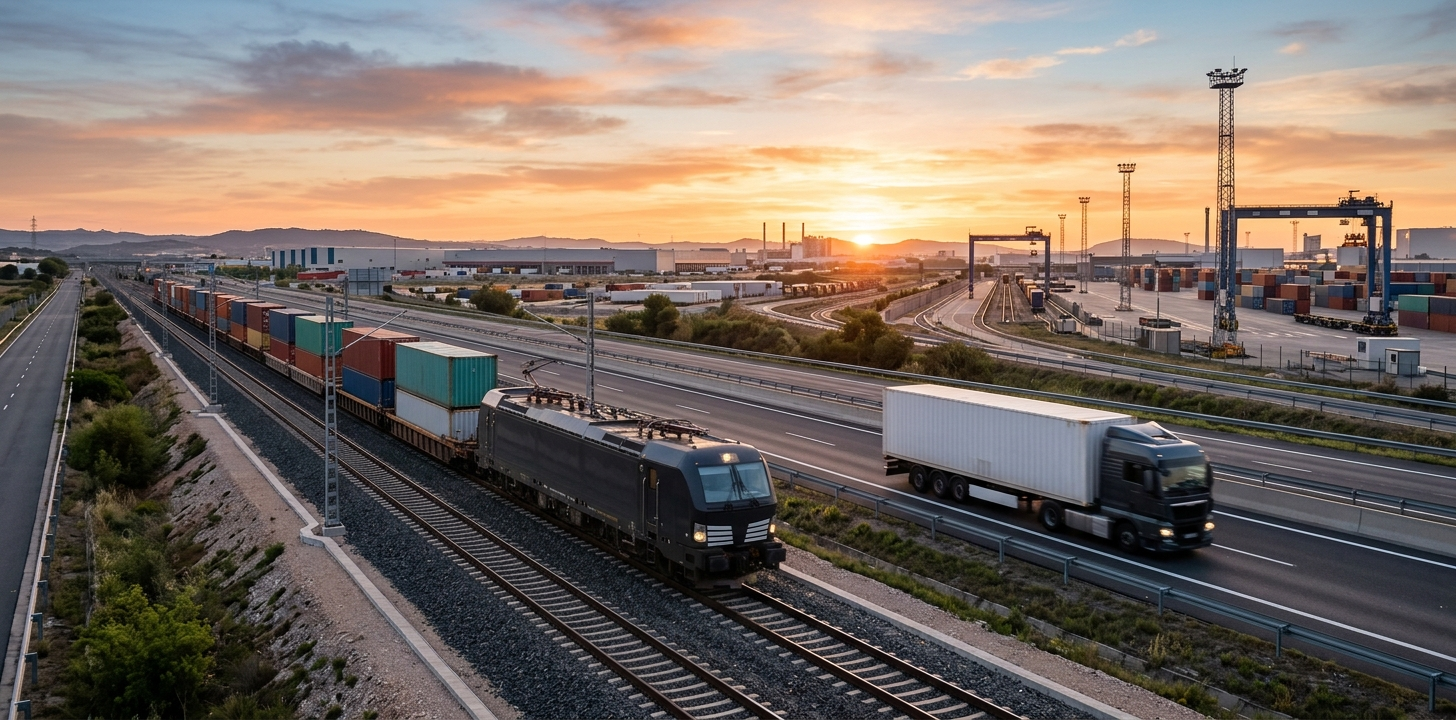
In 2026, choosing between rail freight and road freight is no longer a purely operational decision. Instead, it has become a strategic trade-off that directly impacts total logistics cost, supply chain reliability, and ESG performance.
However, many companies still approach this decision with a simplified question: which mode is cheaper? At first glance, this seems logical. Yet in practice, this question often leads to the wrong conclusion.
The reason is simple: freight cost is not a single number—it is a system.
Reality: Rail and road do not compete on price—they compete on cost structure
Rail and road freight are often compared as if they behave similarly. However, in reality, they operate under very different cost structures.
On the one hand, road freight is built for flexibility. Therefore, trucks can move quickly, adjust routes, and deliver directly. As a result, road transport performs well in short-distance and time-sensitive scenarios.
However, this flexibility introduces exposure. For example, fuel price volatility, driver availability, congestion, and regulatory limits all affect cost. Consequently, the final price often deviates from the initial quote.
On the other hand, rail freight is designed for scale and stability. Therefore, trains move large volumes over fixed corridors with lower energy consumption per ton-kilometer. In addition, rail systems typically operate with more predictable scheduling.
So, while road optimizes for flexibility, rail optimizes for efficiency. Therefore, this structural difference explains why cost outcomes diverge.
Where the model breaks: Why “cheaper” is often miscalculated
Many logistics teams assume that comparing rates is enough. However, this approach fails in several important ways.
First, it ignores cost structure. As a result, a lower rate does not necessarily mean a lower total cost.
Second, it assumes stable conditions. However, road freight operates in a highly volatile environment.
Third, it overlooks operational execution. In rail, efficiency depends on how well the system runs.
Because of these gaps, two similar shipments can lead to very different outcomes.
For example, a road shipment may appear cheaper initially. However, delays, fuel adjustments, and operational issues may increase the final cost. Meanwhile, a rail shipment may seem expensive upfront. However, it often remains stable throughout execution.
Therefore, the real problem is not the data—it is the interpretation.
When each model works: Not better—just more suitable
Instead of asking which mode is better, it is more useful to ask under what conditions each mode performs well.
Road freight performs best when flexibility matters more than efficiency. For example, this includes short-haul, fragmented, or urgent deliveries.
By contrast, rail freight performs better when volume, distance, and predictability increase. Therefore, its structural efficiency becomes more visible in long-distance scenarios.
This distinction is critical. It shows that transport choice is conditional, not absolute.
Decision Framework: How to choose the right mode
To move from theory to action, logistics teams need a simple decision filter.
| Factor | Rail Advantage Condition | Interpretation |
|---|---|---|
| Distance | Long-haul (500km+) | Fixed costs spread better |
| Volume | High and consistent | Efficiency increases |
| Scheduling | Predictable | Reduces hidden costs |
| Flexibility need | Low | Rail performs better |
This framework does not give a binary answer. Instead, it helps identify alignment.
Therefore, the closer your shipment conditions match these factors, the stronger the case for rail.
Why this matters more in 2026
In previous years, cost comparison focused mainly on rates. However, in 2026, risk has become a central factor.
For example, road freight faces increasing volatility due to fuel pricing, labor shortages, and regulatory pressure. In addition, ESG reporting introduces new cost dimensions.
As a result, companies now evaluate transport based on cost stability and long-term exposure.
In this context, rail offers a structural advantage. Not because it is always cheaper, but because it is more predictable.
At Arta Rail, this is exactly how transport decisions are evaluated: not as rate comparisons, but as system-level cost decisions.
Final insight: From comparison to decision
Rail vs road is not a simple comparison—it is a decision model.
When companies focus only on rates, they often miss key cost drivers. However, when they understand cost structure and operational behavior, the decision becomes clearer.
Therefore, the real advantage does not come from choosing the cheaper option. Instead, it comes from choosing the right option for the right conditions.
And in 2026, that distinction matters more than ever.
When Rail Freight Clearly Outperforms Road Freight — and When It Doesn’t
By 2026, the key question in freight planning is no longer whether rail freight or road freight is “better.” The real question is under which conditions each mode delivers superior outcomes.
Many logistics strategies still rely on habit. Companies repeat the same transport choices across different routes, volumes, and timelines. In practice, this approach creates hidden inefficiencies. Cost increases, delivery performance becomes inconsistent, and exposure to volatility grows over time.
A more effective approach is scenario-based decision-making. Instead of choosing a mode, high-performing logistics systems match the mode to the conditions.
This section focuses on those conditions.
Scenario 1: Long-Distance, High-Volume Transport
Rail freight starts to show structural advantage when distance and volume increase together.
In long-haul transport, typically above 500 to 700 kilometers, the cost behavior of rail and road begins to diverge. Rail systems distribute fixed costs across larger volumes, while operational efficiency improves with scale.
Road freight behaves differently. Each additional kilometer and each additional ton directly increases fuel consumption, driver hours, and maintenance requirements. This creates a linear cost structure.
Under stable conditions, this difference may appear manageable. However, in 2026, cost volatility amplifies the gap. Fuel price fluctuations and labor constraints make road freight increasingly sensitive to external shocks.
Rail freight absorbs these pressures more effectively because its cost structure is less dependent on real-time variables.
The result is not simply lower cost, but more stable cost.
Key takeaway:
Long-distance, high-volume cargo aligns with the strengths of rail. In these conditions, rail is not just cheaper — it is structurally more efficient.
Scenario 2: Time Sensitivity vs Time Reliability
Speed is often treated as a primary decision factor. However, in real logistics systems, consistency matters more than peak performance.
Road freight performs well in short, direct routes where delays are minimal. Over longer corridors, performance becomes less predictable. Traffic congestion, regulatory driving limits, and operational disruptions introduce variability.
This variability has a cost. Not always in transport pricing, but in downstream operations.
Rail freight operates differently. Its advantage is not maximum speed, but schedule stability. Fixed timetables and controlled infrastructure reduce unexpected variation in transit time.
In industries where production depends on predictable supply, this difference becomes critical. Steel production, cement distribution, agricultural logistics, and petrochemical supply chains rely on timing consistency.
In these environments, variability is more damaging than slower delivery.
Key takeaway:
When reliability matters more than speed, rail freight provides stronger operational performance.
Scenario 3: Sustainability, ESG, and Cost Exposure
Sustainability is no longer a secondary factor in transport decisions. In 2026, it directly influences procurement, compliance, and long-term cost structure.
Rail freight produces significantly lower emissions per ton-kilometer compared to road transport. At scale, this difference becomes measurable and financially relevant.
Carbon accounting frameworks continue to evolve. As they mature, emissions are no longer abstract metrics. They translate into reporting obligations, supplier evaluations, and in some cases, direct cost exposure.
Road freight carries higher long-term risk in this context. Its emissions profile creates vulnerability as carbon-related costs increase.
Rail freight reduces this exposure.
The impact is not limited to environmental reporting. It affects competitive positioning, contract eligibility, and alignment with global supply chain standards.
Key takeaway:
When sustainability and long-term risk are part of the decision, rail becomes the more resilient choice.
Scenario 4: Where Road Freight Still Dominates
Despite its advantages, rail freight is not universally optimal.
There are conditions where road freight remains more effective, primarily when flexibility outweighs efficiency.
Short distances reduce the advantage of rail. Low volumes prevent cost distribution. Urgent deliveries require immediate dispatch. Door-to-door service eliminates transfer steps.
Rail infrastructure introduces constraints in these scenarios. Fixed routes and terminal dependencies can increase handling complexity.
In such cases, road freight delivers better performance.
Key takeaway:
For short-haul, time-critical, and highly flexible operations, road transport remains essential.
Multimodal Strategy: The Real Optimization Layer
The most effective logistics systems do not rely on a single mode.
They combine rail and road.
Rail handles long-distance efficiency. Road handles first-mile and last-mile flexibility. The connection point is critical. Inland terminals and dry ports enable this transition.
This approach shifts the decision from mode selection to system design.
Instead of asking which mode is better, the focus moves to how modes interact.
This is where logistics strategy becomes scalable.
Decision Matrix: Mode Selection by Scenario
| Use Case | Best Mode |
|---|---|
| Long-distance, high-volume cargo | Rail Freight |
| Predictable industrial supply chains | Rail Freight |
| Short-haul or urgent delivery | Road Freight |
| Door-to-door, low volume | Road Freight |
| Cost and carbon optimized networks | Multimodal |
Section 2 Summary: From Mode Selection to System Thinking
Transport mode selection in 2026 is not a binary decision.
Rail freight performs best under scale, distance, and predictability. Road freight performs best under flexibility, urgency, and fragmentation.
The most competitive logistics strategies integrate both.
At Arta Rail, freight planning is approached as a system-level decision. The goal is not to choose a mode, but to design a network that balances cost, reliability, and long-term resilience.
In Section 3, the focus shifts to execution. We will examine how companies calculate real return on investment when shifting from road to rail, where implementation challenges appear, and how structured planning reduces risk in practice.
Calculating Real ROI, Overcoming Implementation Barriers, and Choosing the Right Freight Strategy in 2026
By 2026, shifting freight from road to rail is no longer a conceptual sustainability initiative. It is a measurable financial decision that directly affects cost structure, operational risk, and long-term competitiveness.
Many companies hesitate to make this shift. The hesitation is rarely about rail freight itself. In most cases, the issue lies in how return on investment is evaluated and how the transition is executed.
This section focuses on three practical questions: how to calculate real ROI, how to address implementation barriers, and how to select a freight strategy that aligns with business conditions.
Calculating Real ROI: Moving Beyond Freight Rates
A common mistake in freight planning is comparing headline transport rates. This approach simplifies the decision, but it ignores how cost behaves over time.
Real ROI appears when total logistics cost and risk exposure are evaluated together.
In road-dominant models, several cost components are often underestimated or excluded:
- Fuel price volatility and surcharge adjustments
- Driver availability, overtime, and labor pressure
- Congestion-related delays and operational penalties
- Higher insurance exposure on long-haul trucking
- Carbon-related costs tied to ESG and compliance frameworks
These factors do not always appear in initial pricing. However, they accumulate over time and change the total cost outcome.
Rail freight interacts with these variables differently. Its dependence on fuel fluctuations is lower. Labor intensity is reduced. Scheduling is more structured. As a result, cost behavior becomes more stable rather than reactive.
The difference is not just cost level, but cost predictability.
| Cost Factor | Road Freight | Rail Freight |
|---|---|---|
| Cost predictability | Low | High |
| Fuel sensitivity | High | Low |
| Labor dependency | High | Low |
| Emissions per ton-km | High | Low |
| Long-term scalability | Limited | Strong |
When these variables are modeled across annual shipment volumes, the outcome becomes clearer. In many regional and cross-border corridors, rail freight does not just reduce cost. It reduces volatility.
That distinction is what defines real ROI.
Where ROI Calculations Fail
ROI models often fail for one reason: they assume stable conditions.
In reality, freight systems operate under uncertainty. Road transport absorbs most of that uncertainty through fluctuating variables. Rail systems, by contrast, shift the focus toward operational planning.
When companies compare a fixed rail rate to a current road rate, they often underestimate future variability. This leads to short-term decisions that ignore long-term cost exposure.
A more accurate approach evaluates how each mode behaves under stress conditions, not just under normal conditions.
Implementation Barriers: Why Transition Is Slower Than Expected
Even when the financial case for rail is clear, implementation introduces challenges. These challenges are not theoretical; they are operational.
The first barrier is infrastructure access. Rail requires integration with terminals, inland hubs, or dry ports. Without proper planning, additional handling steps can reduce efficiency.
The second barrier is perceived rigidity. Rail is often associated with fixed schedules and limited flexibility. This perception discourages adoption, even when it does not fully reflect modern logistics practices.
The third barrier is internal resistance. Teams that are used to road transport often default to familiar processes, even when alternative models perform better.
These barriers do not eliminate the value of rail. They delay the transition.
Overcoming Barriers: From Resistance to Structured Adoption
Addressing these challenges requires a structured approach rather than a full system shift.
Pilot programs are often the most effective starting point. They allow companies to test rail performance on selected routes without committing to full migration. This reduces perceived risk and generates real performance data.
Integration is equally important. Rail does not replace road—it complements it. Effective systems connect rail corridors with road-based first-mile and last-mile operations.
Planning discipline also plays a role. Rail benefits from structured scheduling, consolidated volumes, and predictable flows. When these elements are present, perceived rigidity becomes operational stability.
This is where logistics shifts from execution to design.
Multimodal Execution: Where Strategy Becomes Practical
By 2026, the most resilient logistics systems are not rail-based or road-based. They are multimodal.
Rail handles the long-distance, cost-intensive segments. Road ensures flexibility at the edges of the network.
The connection layer is critical. Inland terminals and dry ports enable smooth transitions between modes. They reduce congestion, move consolidation closer to origin points, and improve timing consistency.
This structure improves both cost efficiency and system resilience.
Instead of choosing between modes, companies design how modes interact.
Decision Checklist: Is Rail Freight Aligned with Your Operations?
The following checklist helps translate analysis into action:
- Are shipment volumes consistent and scalable?
- Do routes regularly exceed 500 kilometers?
- Is cost predictability more valuable than maximum speed?
- Are sustainability targets influencing procurement decisions?
- Can operations support planned scheduling instead of ad-hoc dispatching?
If most of these conditions apply, rail—or a rail-road multimodal model—becomes a logical component of the freight strategy.
Why Arta Rail Fits the 2026 Freight Model
At Arta Rail, freight planning is approached as a system-level design problem rather than a transport choice.
Instead of offering a single mode, the focus is on building integrated solutions based on:
- Corridor-based rail optimization
- Inland terminal and dry port connectivity
- Seamless integration with road networks
- Cost, carbon, and reliability performance metrics
This approach allows businesses to transition from road-heavy models to scalable, structured logistics systems without disrupting operations.
Final Conclusion: From Mode Comparison to Strategic Design
By 2026, the rail versus road discussion is no longer theoretical.
Rail freight delivers stronger performance in long-distance, high-volume, and sustainability-driven scenarios. Road freight remains essential for flexibility, urgency, and last-mile execution.
The advantage does not come from choosing one mode over the other.
It comes from understanding when each mode works—and designing a system that uses both effectively.
Companies that apply this logic move beyond cost comparison. They build freight strategies that are more predictable, more resilient, and better aligned with long-term business goals.