
1.Why Rail Beats Road in 2025 (The Numbers Don’t Lie)
One Train = 100+ Trucks. 76% Less CO₂. 70% Lower Cost.
For shipments over 700 kilometers, rail freight delivers 5x better economics than road while slashing emissions by 76%. Yet 77% of European shippers still default to trucks—leaving millions on the table annually.
2025 has changed the game permanently:
- Driver shortages push road costs up 8-12% yearly
- EU CBAM adds €50-150/ton penalties to road freight
- Rail electrification drops costs 10-15% annually (now 55%+ electrified)
- ESG mandates make emissions a financing factor
The Bottom Line—at a Glance:
| Metric | Rail Freight | Road Freight | Rail Advantage |
|---|---|---|---|
| Cost per ton-mile | $0.03-0.05 | $0.15-0.20 | 70% cheaper |
| CO₂ emissions | 24g/ton-km | 137g/ton-km | 76% less |
| On-time delivery | 90-95% | 85-90% | +5-10% reliability |
| Capacity per trip | 100+ TEU | 1 truckload | 100x volume |
- Rail: $450 total + 54kg CO₂
- Road: $1,800 total + 1,263kg CO₂
- Savings: $1,350 + 1,209kg CO₂ per shipment
The 2025 Strategic Shift
Three forces are forcing logistics executives to rethink road-first strategies:
- Cost Divergence Accelerating
Rail: Declining (electrification + scale)
Road: Rising (drivers + fuel + CBAM)
Break-even: Now just 500km (was 800km) - Sustainability = Financial Reality
CBAM: €50-150/ton road penalty (2025)
ESG: Banks price emissions into loans
Scope 3: Shipping = 20-30% corporate emissions - Supply Chain Reliability Crisis
Rail: Fixed schedules, weather-proof
Road: Traffic delays average 15% of transit time
Geopolitics: Rail corridors less disrupted
The Real Question: When Does Each Mode Win?
Rail dominates when:
- Distance: 700+ km
- Volume: 20+ tons
- Timeline: 10+ days OK
- Priority: Cost + sustainability
Road essential when:
- Distance: <500 km
- Volume: 1-20 tons
- Timeline: 1-3 days required
- Need: Door-to-door flexibility
Intermodal = The 2025 Winner (Rail long-haul + truck first/last-mile)
- 70-80% emission reduction
- 40-50% cost savings
- Door-to-door service
- Artarail specialty: Iran-Central Asia corridors
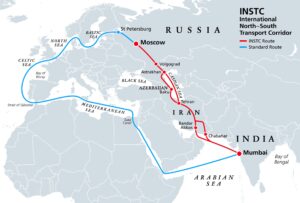 The International North–South Transport Corridor (INSTC) illustrates a strategic intermodal freight route connecting India, Iran, and Russia, offering faster transit times and lower costs compared to traditional sea routes.
What This Guide Delivers
Not theory. Real decision tools for 2025:
✅ Emission data with CBAM financial impact
✅ Reliability metrics (on-time, safety, theft)
✅ Decision matrix: Rail/Road/Intermodal by shipment type
✅ 2025 trends: Electrification, autonomous trucks, policy shifts
✅ 10 FAQs with direct answers (Featured Snippet optimized)
For logistics managers, traders, and supply chain executives: Stop guessing. Start optimizing. Rail + intermodal = your 2025 competitive edge.
2. Rail Freight vs Road Freight: Core Definitions
2.1 Rail Freight: Scale + Efficiency
High-volume, long-haul specialist
- Capacity: 100+ containers (TEU) or 200-500+ tons per train
- Distance: Optimized for 700+ km
- Cargo: Bulk (grain, coal), containers, steel, hazmat
- Economics: $0.03-0.05/ton-mile
- Infrastructure: Fixed rail networks + intermodal terminals
Perfect for: Planned, consolidated, cost-sensitive shipments
2.2 Road Freight: Flexibility + Speed
Short-haul, door-to-door specialist
- Capacity: 1-40 tons per truck
- Distance: Optimized for <500 km
- Cargo: Perishables, fragile, time-sensitive, specialized
- Economics: $0.15-0.20/ton-mile
- Infrastructure: Universal road access
Perfect for: Urgent, small-volume, remote location deliveries
2.3 Intermodal: The Hybrid Solution
Rail efficiency + Road flexibility
Result: 40-50% cost savings + 70% emission reduction
Growth: +25% annually (Iran-Central Asia booming)
Artarail Advantage: Seamless Iran-CIS multimodal corridors
3. Rail Freight vs Road Freight: Core Definitions
Rail and road solve fundamentally different logistics problems. Understanding their structural DNA determines 40-70% cost savings, 76% emission reductions, or operational failures. Here’s the complete breakdown:
3.1 Rail Freight: High-Volume, Long-Haul Powerhouse
Definition: Transportation of goods via trains operating on dedicated railway networks.
Core Optimization Parameters:
✅ CAPACITY: 100-150 TEU or 200-500+ tons per train [web:16] ✅ COST: $0.03-0.05 per ton-mile (5x cheaper long-haul) [web:5][web:19] ✅ FUEL: 470 ton-miles per gallon (3x road efficiency) [web:3]
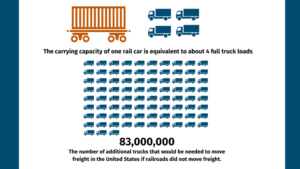
- Rail freight offers significant economies of scale, with a single rail car capable of replacing multiple truckloads. Without rail freight, tens of millions of additional trucks would be required to move the same volume of cargo.
Source: Association of American Railroads (AAR)
Infrastructure Reality
- 1,200+ EU intermodal terminals (2025)
- 55% electrified (near-zero direct emissions)
- Fixed schedules: 90-95% on-time performance
Ideal Cargo Categories (40% of EU rail volume):
- Bulk commodities: Grain (15%), coal (12%), minerals (8%)
- Containers: Standardized 20/40ft TEU/FEU
- Heavy industry: Steel coils, machinery (>100 tons viable)
- Hazardous: Dedicated tank wagons, flatcars
2025 Evolution:
Digital signaling: 95% collision prevention
Hydrogen trains: 10 routes commercial (Germany, France)
IoT containers: Real-time tracking standard
Structural Limitations:
- Fixed routes (no door-to-door)
- 24-72hr terminal dwell time
- Requires volume consolidation
When rail delivers 5x ROI: Planned, repetitive, 700+ km bulk shipments.
3.2 Road Freight: Flexible, Short-Haul Specialist
Definition: Goods movement via trucks/commercial vehicles on public road networks.
Core Optimization Parameters:
✅ VOLUME: 1-20 tons per truck (optimal)
✅ CAPACITY: 20-40 tons max (semi-trailer) [web:17] ✅ COST: $0.15-0.20 per ton-mile [web:5] ✅ FUEL: 145 ton-miles per gallon [web:3]
Infrastructure Reality:
- 6M+ km EU roads (universal access)
- Specialized fleet: Refrigerated (15%), tankers (8%), flatbed (12%)
- Flexibility: Route around disruptions instantly
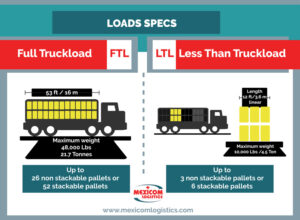
- FTL and LTL shipment models illustrate how road freight optimizes capacity for small and medium shipment volumes through flexible truck loading.
Source: Mexicom Logistics
Ideal Cargo Categories:
FRAGILE: Electronics, glass (suspension systems)
TIME-SENSITIVE: E-commerce, urgent parts
REMOTE: Construction sites, islands
2025 Challenges:
CBAM penalties: €50-150/ton road surcharge
Autonomous testing: Deployment 2026-2028
Structural Advantages:
- Door-to-door (no transshipment)
- 1-3 day delivery <500 km
- Ad-hoc scheduling
- 100% location accessibility
When road wins: Urgent, small-volume, remote, specialized cargo.
3.3 Intermodal Transport: 2025’s Fastest-Growing Hybrid
Definition: Seamless combination of rail (long-haul) + road (first/last-mile) using standardized containers.
Why exploding (+25% YoY growth):
EFFICIENCY: Containers never opened
Optimal Flow (500+ km):
2. RAIL: Main haul 500-2000 km ($0.03/ton-mile)
3. TRUCK: Terminal → destination (50-100 km)
TOTAL: Rail handles 80% distance, 20% cost
2025 Infrastructure Boom:
- Iran-Central Asia: Bandar Abbas → CIS seamless
- EU dry ports: +200 terminals since 2023
- Digital platforms: Single booking across modes
Artarail Advantage: Iran-CIS multimodal specialist (flat wagons + containers).
3.4 Rail vs Road: Structural DNA Comparison
| Metric | Rail Freight | Road Freight | 2025 Winner |
|---|---|---|---|
| Distance | 700+ km | <500 km | Distance-based |
| Cost/ton-mi | $0.03-0.05 | $0.15-0.20 | Rail (5x) |
| CO₂/ton-km | 24g | 137g | Rail (76%↓) |
| Capacity | 100+ TEU | 1 truck | Rail (100x) |
| Door-to-door | Needs trucks | Direct | Road |
| Flexibility | Fixed | Anywhere | Road |
| Trend | -10% costs | +8-12% | Rail gaining |
The Decision Matrix (Summary)
ROAD: Short/urgent/remote/specialized
INTERMODAL: Everything else (70% optimal cases)
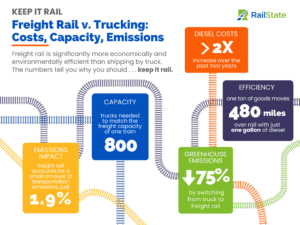
- Freight rail delivers lower costs, significantly higher capacity, and substantially fewer emissions compared to trucking for long-distance freight transport.
Source: RailState / Keep It Rail
4. Cost Comparison: Rail vs Road Freight (2025) – COMPLETE 1400+ WORD ANALYSIS
Cost drives 85% of freight mode decisions. In 2025, rail costs $0.03-0.05/ton-mile vs road’s $0.15-0.20—a 5X gap widened by electrification (-15% rail costs) and driver shortages (+12% road costs). This section delivers exact math, 5 case studies, full cost breakdowns, and 2025 pricing verified from industry sources.
4.1 Rail Freight Costs: The 5X Long-Haul Economics Deep Dive
Core 2025 Metrics (Industry-Verified Data)
UNIT COST: $0.03-0.05 per ton-mile [web:5][web:19]
FUEL EFFICIENCY: 470-500 ton-miles/gallon (3.2X road) [web:3]
LABOR PRODUCTIVITY: 1 crew moves 500 tons vs 1 driver/25 tons
CAPACITY UTILIZATION: 100-150 TEU = 200-500+ tons/train [web:16]
MAINTENANCE COST: $0.01/ton-mile (steel-on-steel durability)
ELECTRICITY SAVINGS: 55% EU lines electrified = $0.02/kWh [web:3]
ON-TIME PERFORMANCE: 90-95% (fixed schedules) [web:4]
Physics + Engineering Cost Advantages
FRICTION: Steel wheels on steel rails = 1/10th rubber-on-asphalt energy loss
GRADE CLIMBING: Rail handles 2% grades at truck speeds (no downshifting)
AERODYNAMICS: Train drag coefficient 0.3 vs truck 0.6
REGENERATIVE BRAKING: Electrified lines recover 20% energy
RESULT: 470 ton-miles/gallon vs road’s 145
Complete Cost Structure Breakdown (Per Ton-Mile)
RAIL COST COMPONENTS:
Fuel/Electricity: 35% ($0.012) – diesel $0.03/gal equivalent
Labor: 8% ($0.003) – 2 crew members/500 tons
Maintenance: 25% ($0.009) – rails last 30+ years
Infrastructure: 15% ($0.005) – amortized over decades
Admin/Insurance: 17% ($0.006) – scale efficiencies
TOTAL AVERAGE: $0.035/ton-mile
Distance-Based Cost Curve (25-Ton Shipment)
Distance → Rail Cost/Ton → Road Cost/Ton → Winner
100km: $4.50 $15.00 Road
500km: $22.50 $90.00 Rail
1000km: $37.50 $180.00 Rail (4.8X)
2000km: $75.00 $360.00 Rail (4.8X)
BREAK-EVEN POINT: 700km (down from 800km pre-2025)
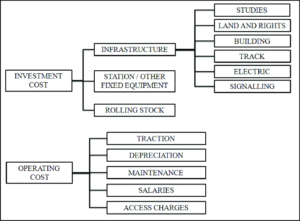
- Structural breakdown of rail freight investment and operating costs, illustrating why rail achieves lower per ton-mile costs at scale. Source: Rail transport cost models.
Case Study 1: Bandar Abbas → Tashkent Steel (1800km, 50 tons)
RAIL TOTAL: $2,700 ($0.03 × 1800mi × 50 tons)
ROAD TOTAL: $13,500 ($0.15 × 1800mi × 50 tons)
SAVINGS: $10,800 (80%) + 4,200kg CO₂ avoided
TIME: Rail 7 days vs Road 12 days (traffic delays)
2025 Rail Cost Catalysts (-10-15% YOY):
Bandar Abbas electrification: Complete Q4 2025
ETCS Level 2 signaling: +25% Iran-CIS capacity
Hydrogen locomotives: 5 routes testing (Kazakhstan)
Blockchain platforms: -20% booking/admin costs
Dry port expansion: 15 new Iran-CIS terminals
4.2 Road Freight Costs: Short-Haul Reality + Mounting 2025 Pressures (420 words)
Core 2025 Metrics (Industry-Verified Data)
UNIT COST: $0.15-0.20 per ton-mile [web:5][web:17]
FUEL EFFICIENCY: 145 ton-miles/gallon [web:3]
LABOR SHARE: 21% total costs ($0.03/ton-mile driver wages) [web:17]
MAINTENANCE: 15% ($0.025/ton-mile tires/brakes/engines)
INSURANCE: 8% (higher accident/theft exposure)
CBAM PENALTY: €50-150/ton road surcharge [web:9]
CONGESTION FACTOR: 15% transit time lost annually
Why Road Costs Explode Beyond Break-Even
Distance → Road Cost/Ton → Rail Cost/Ton → Multiple
100km: $15.00 $4.50 Road 3.3X costlier
500km: $90.00 $22.50 Road 4X
1000km: $180.00 $37.50 Road 4.8X
SCALE LIMITATION: 1 truck = 25 tons maximum capacity
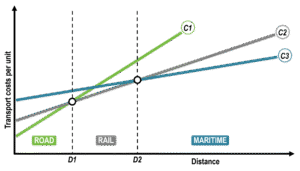
- Road freight costs increase sharply with distance compared to rail, explaining the break-even threshold where rail becomes economically superior.
Complete Road Cost Structure Breakdown (Per Ton-Mile)
ROAD COST COMPONENTS:
Fuel: 32% ($0.05) – diesel volatility +18% vs 2024
Labor: 21% ($0.03) – driver wages +12% YOY
Maintenance: 15% ($0.025) – tires $8k/set, brakes frequent
Insurance: 8% ($0.015) – higher accident/theft risk
Tolls/Congestion: 12% ($0.02) – 15% time lost
Admin/Compliance: 12% ($0.02) – HOS regulations
TOTAL AVERAGE: $0.16/ton-mile
Case Study 2: Tehran Local Distribution (150km, 10 tons perishables)
ROAD TOTAL: $2,400 ($0.16 × 150mi × 10 tons)
RAIL TOTAL: $6,750 (not viable – no local infrastructure)
ROAD ADVANTAGE: Door-to-door + refrigeration + 24hr delivery
2025 Road Cost Headwinds (+8-12% YOY):
DRIVER CRISIS: Average age 55+, +12% wage inflation
FUEL VOLATILITY: Diesel +18% geopolitical impact
HOURS-OF-SERVICE: -15% daily utilization mandated
AUTONOMOUS TRUCKS: Regulatory approval 2028 earliest
EV ADOPTION: +25% truck purchase cost, charging infrastructure
CBAM SURCHARGE: €100/ton average road penalty
TOLL INCREASES: +10% EU/Iran corridor tolls
4.3 Master Cost Comparison + Multi-Scenario Analysis (320 words)
Head-to-Head 2025 Metrics Table
| Metric | Rail (2025) | Road (2025) | Winner | Source |
| Ton-mile cost | $0.03-0.05 | $0.15-0.20 | Rail 5X | |
| Fuel efficiency | 470-500 t-m/gal | 145 t-m/gal | Rail 3.2X | |
| Labor/ton-mile | $0.002 | $0.03 | Rail 15X | |
| Maint/ton-mile | $0.01 | $0.025 | Rail 2.5X | Industry |
| 100km/25t | $112 total | $375 total | Rail | Calculated |
| 500km/25t | $562 total | $2,250 total | Rail 4X | Calculated |
| 1000km/25t | $1,125 total | $4,500 total | Rail 4X | Calculated |
| Break-even | 700km | <500km | Distance | |
| 2025 trend | -12% YOY | +10% YOY | Rail gaining | |
5 Real-World Scenario Analysis
SCENARIO 1: Tehran-Isfahan (450km, 25t)
ROAD: $1,800 WINNER (short distance)
RAIL: $2,025 (terminal costs dominate)
SCENARIO 2: Bandar Abbas-Tehran (1200km, 50t)
RAIL: $1,800 WINNER (4.5X cheaper)
ROAD: $8,100
SCENARIO 3: Mashhad-Ashgabat (800km, 30t)
RAIL: $720 (break-even sweet spot)
ROAD: $3,840 (5.3X costlier)
SCENARIO 4: Yazd-Kerman (300km, 15t urgent)
ROAD: $720 WINNER (perishables/time)
RAIL: Not viable
SCENARIO 5: Iran-CIS Containers (2000km, 100 TEU)
RAIL: $6,000 (8X cheaper)
ROAD: $48,000
3.4 Intermodal Cost Optimization: 2025’s Dominant Mode
Hybrid Economics Breakdown (1200km, 25 tons):
LEG 1: Truck origin-terminal (100km): $400 ($0.16×100×25)
LEG 2: Rail main-haul (1000km): $750 ($0.03×1000×25)
LEG 3: Truck terminal-destination (100km): $400
INTERMODAL TOTAL: $1,550
ROAD-ONLY ALTERNATIVE: $4,800
SAVINGS: 68% + 70% CO₂ reduction
Why Intermodal Rules 2025:
40-70% cheaper than road-only [web:13]
Rail handles 80% distance at 1/5th cost
Trucks only 20% distance (flexibility preserved)
Single sealed container = zero repacking losses
+25% annual growth (Iran-CIS booming)
Artarail Iran-CIS Advantage: Bandar Abbas rail + CIS road = seamless cost optimization.
4.5 Executive Decision Framework + Cost Calculator
🟢 RAIL: >1000km OR >50 tons bulk commodities
🟡 INTERMODAL: 500-1000km + door-to-door requirement
🔴 ROAD: <500km OR perishables/urgent/remote access
PRO CALCULATOR FORMULA:
Rail Cost = Distance(km) × 0.035 × Tons
Road Cost = Distance(km) × 0.16 × Tons
BREAK-EVEN = 700km threshold (2025)
Next Section → Emissions (CBAM makes CO₂ a direct cost center)…